This article is a summary of “[Deep Dive] The Age of Q: Re-Mapping the Chip Supply Chain on a ₩3,200 Trillion Order Book,” published for subscribers on July 16, 2026. Figures and target prices are available in the original.
Previous installments: “After HBM, We Look for Alpha in Front-End Equipment” (Jan 26) · Three-Month Check-Up (Apr 6) · Front-End Materials & Consumables (May 18) · Back-End Equipment (Jun 15)
Buongiorno.
In July, two events arrived in the same week.
On June 29, Samsung Electronics (005930 KS) and SK hynix (000660 KS) disclosed the largest long-term semiconductor investment plans in history, a combined ₩3,200 trillion (roughly $2.3 trillion). Three days later, on July 2, the KOSPI fell 7.89% in a single day. The largest capex announcement on record and a crash-scale drop, side by side in one week.
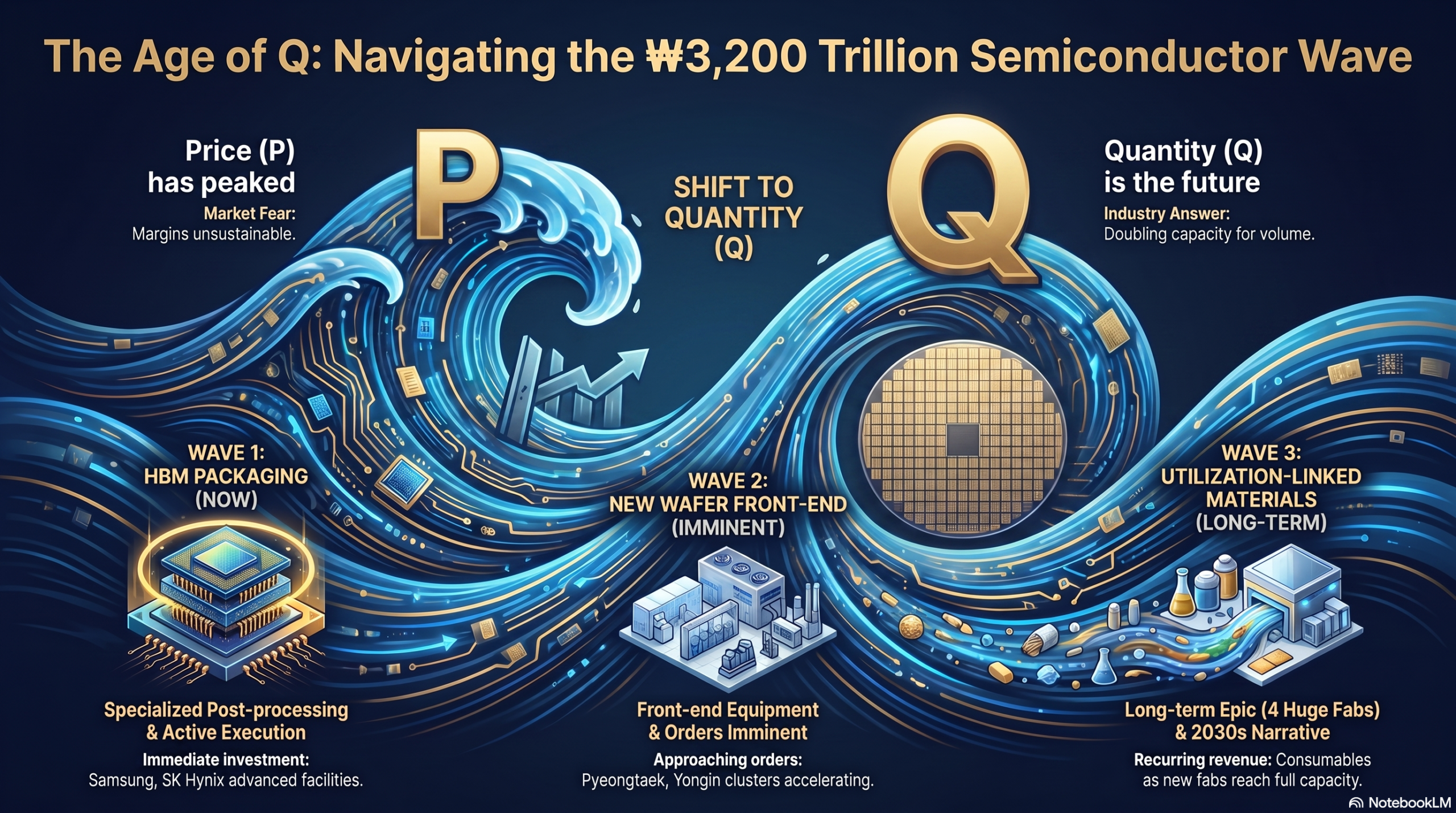
The two look contradictory, but they are, I think, the front and back of the same question. To answer it, today we put the three parts of the chip supply chain we covered this year — front-end equipment, materials and consumables, and back-end equipment — on a single map. I think of each part as a field, and of each company in it as a seed. This is, I believe, unmistakably the age of Q — Q for quantity.
The Wide View: At the Peak of P, What the Market Fears
Let’s zoom out first.
The memory industry appears to be at the peak of price (P). Earnings show how far P has climbed. SK hynix reported first-quarter revenue of ₩52.6 trillion and operating profit of ₩37.6 trillion (per company disclosure), an operating margin of 72%, a number rarely seen in manufacturing. Reports say Apple is raising prices across its entire product line, citing the burden of memory costs. Buyers can barely carry the price.
And this week, two more reports confirmed how high this mountain stands. On July 15, ASML ($ASML) beat consensus with second-quarter revenue of €9.33 billion and raised third-quarter guidance sharply. The next day, TSMC ($TSM) landed exactly at the top of its own guidance with quarterly revenue of $40.2 billion, up 33.7% year over year. The results of the lithography monopolist and the world’s largest foundry work as a thermometer for the industry’s capital spending. That thermometer rose twice this week.
So why is the market this frightened?
The trigger for the July 2 crash was Meta’s ($META) neocloud announcement. Its plan to sell surplus AI compute to outside customers was read as “compute is abundant, so memory demand fades, so the cycle ends.” Micron ($MU) and SanDisk ($SNDK) tumbled, and Samsung Electronics and SK hynix followed.
Look closer at the three peaks, though, and their circumstances differ. Samsung Electronics slipped even after beating expectations, and part of that likely reflects the market pricing in a change to its cost structure. Micron posted excellent results and then announced aggressive expansion, and some of the hesitation reads as wariness that today’s new supply could return as a glut a few years from now. SK hynix holds the only new story of the three, with its own re-rating path now open. And yet the three peaks still rise together and fall together. So what moves this mountain right now is not individual fundamentals but a shared fear.
Summarize that fear in one sentence: “P built this mountain. If P breaks, the mountain collapses.” The market is frightened in the language of P.

The Age of Q: The Only Way to Defend the Mountain
The memory trio’s answer, I think, came in a different language: quantity (Q).
A P that already yields a 72% operating margin has little room to rise much further. To defend a mountain of profit built on P alone, only one variable remains: make more and sell more. So the current phase reads as offense and defense. The market attacks with “then P will fall,” and the trio has to defend with “hold P, grow Q.”
What matters is that this defense is no longer just words. It is already committed capital.
First, the filings. Samsung Electronics disclosed ₩2,100 trillion for semiconductors through 2040 (₩1,650 trillion for Yongin and existing campuses plus ₩400 trillion for new sites), and SK hynix disclosed ₩1,100 trillion (₩600 trillion for Yongin, ₩100 trillion for Cheongju, ₩400 trillion for the southwest region). Korea’s government has set a target of doubling DRAM capacity within five years. Micron raised its US investment from $200 billion to $250 billion and announced a Taiwan fab acquisition and a Hiroshima investment in quick succession.
Second, this is not one company’s decision but simultaneous action by all three. If rivals expand while you pause, you give up market share, so the direction looks hard to reverse.
Third, this week’s earnings season confirmed the thesis from a third party. ASML’s management said memory pricing and supply conditions are pushing customers to expand capacity, and noted order visibility extending into 2028. On top of that come reports that ASML is pushing equipment price increases and that TSMC is raising prices on advanced nodes. The tollbooths at the bottleneck have started adding price increases on top of volume.
Here is the core distinction of this piece. The debate over P’s peak and the start of Q’s cycle are separate stories. The memory trio’s share prices cannot escape the P debate, but revenue across the chip supply chain never came from P in the first place. Equipment makers are paid by orders; materials and consumables makers are paid by fab utilization. The supply chain’s native language is Q. While fear of peak P dragged the whole market down, companies whose Q expansion is locked in by public filings were discounted along with it. That is the reason for this re-examination.
The Order Map: A Timetable for ₩3,200 Trillion
The headline number alone cannot drive an investment decision. It is a plan running to 2040, and Samsung filed a same-day correction noting that it “may change with market and business conditions.” What matters is not the total but the timetable: when, and at which process step, does this money actually get spent?
First arrival: HBM packaging. Being executed now. Samsung Electronics and SK hynix disclosed a combined ₩81 trillion of HBM packaging investment in Korea’s Chungcheong region, covering Samsung’s new HBM plants in Onyang and Cheonan and SK hynix’s P&T7 in Cheongju. Amkor Technology Korea, the Korean arm of Amkor Technology ($AMKR), breaks ground on its Gwangju plant in October with total investment above ₩1 trillion. With HBM4 ramping this year and HBM4E early next year, packaging capacity is the investment that cannot wait.
Second arrival: new wafer capacity (front-end). Orders approaching. The substance here is Samsung’s simultaneous construction of P5 and P6 in Pyeongtaek and the shortened completion schedules for the Yongin clusters (by seven years for Samsung and twelve for SK hynix). Equipment orders come before fab construction is finished, so this segment should be tracked through order disclosures rather than announcements.
The long story: four fabs in the southwest. Two each from Samsung and SK, roughly ₩800 trillion. But the sites are still candidates and completion targets stretch into the 2030s and beyond, so we leave this out of today’s coordinates (where each stock’s price sits on our valuation map) and treat it as background: a sign that this cycle is a generation-long story.

In short, this cycle’s spending starts with packaging, new wafer capacity follows, and the southwest belongs to the next generation.
Re-Arranging the Value Chain: Three Waves, Seeds by Position
We merge the three fields into one map. The organizing question is not process taxonomy but which wave a company’s revenue is exposed to. Before naming companies, we mark each position in the supply chain, then place the representative players holding it.
Wave 1. Packaging capex — the field being executed now
In TC bonding and hybrid bonding, BESI and ASMPT (HK: 0522) set the global standard, and Hanmi Semiconductor (042700 KS) holds the position in Korea. Reflow and descum belong to PSK Holdings (031980 KS), and laser annealing and cutting to EO Technics (039030 KS) and DIT (110990 KS). Japan’s Disco (6146 JP) leads the world in dicing and grinding. In test, handlers, and sockets, Advantest (6857 JP) and Teradyne ($TER) effectively split the global market between them, while Techwing (089030 KS), ISC (095340 KS), and Leeno Industrial (058470 KS) each hold their own niche in Korea. In outsourced assembly and test, Amkor Technology is the world’s largest.
Wave 2. New wafer front-end — the field where orders are approaching
Lithography is effectively ASML’s alone. Deposition runs through Applied Materials ($AMAT), Lam Research ($LRCX), and Tokyo Electron (8035 JP) globally, with Wonik IPS (240810 KS), Jusung Engineering (036930 KS), and Eugene Technology (084370 KS) in Korea. Etch runs through the same three global names, and through PSK (319660 KS), TES (095610 KS), and VM (089970 KS) in Korea. VM is the only Korean company supplying dry-etch systems to SK hynix. It recently posted an earnings surprise, and we added it to fill the domestic etch slot that had been empty on our map. Thermal processing and annealing belong to Tokyo Electron and Kokusai Electric (6525 JP) globally, and to HPSP (403870 KS) and Eugene Technology in Korea.
Wave 3. Utilization-linked materials and consumables — the field that repeats as fabs run
In photoresist, etchants, and precursors, the leading Korean names are Dongjin Semichem (005290 KS), Soulbrain (357780 KS), Hansol Chemical (014680 KS), and Duksan Techopia (317330 KS). Silicon and quartz parts and SiC consumables are handled by Worldex Industry & Trading (101160 KS), Wonik QnC (074600 KS), BCnC (146320 KS), Hana Materials (166090 KS), and Tokai Carbon Korea (064760 KS). CMP slurry, coating, and refurbishment belong to KC Tech (281820 KS), KoMiCo (183300 KS), and Hansol IONES (114810 KS).

We also left one field out. Package substrates and their materials (FC-BGA, CCL) form a separate market with its own cycle, so they are excluded here and kept as a candidate for a future deep dive. The upstream of the test chain (probe-card substrates, wafer testers) is likewise noted only as a candidate for expansion.
Valuation: Everyone Took the Correction, but Few Got Cheaper
This section is not the place for target prices or valuation figures. It is where we look, qualitatively, at what this correction actually priced in and what it did not.
Start with the global names. ASML raised its full-year revenue guidance sharply on July 15, yet the share price moved only modestly on the day relative to how far the earnings outlook shifted. Earnings expectations have moved by double digits while the price has not fully kept pace. Advantest is exposed to Q twice over. More wafers mean more chips to test, and as those chips grow more complex, HBM above all, test time per chip rises too. That said, this week’s earnings-season reaction suggests its re-rating has already substantially begun, so from here earnings need to do more of the work. Applied Materials, Lam Research, and Tokyo Electron have not reported yet, so their estimate revisions are not fully in the price. Since all three take orders from the same fabs and the same customers, their late-July and August reports should settle the direction.
In Korea, the correction left some interesting positions. Worldex has long carried a governance discount that the market applied with good reason, and a recent buyback-related disclosure has started to unwind part of it. Whether that continues depends on execution in the second half. Dongjin Semichem was pushed down by sector-wide fear without any bad news from the company itself. Earnings events that will show the direction of Korean NAND investment fall right around the publication of this piece, so the thing to watch is which way they move the market’s view of the stock. HPSP is a case where earnings and risk have moved opposite to the price. It won its patent litigation and improved its earnings, yet the price fell further. Which way that gap closes depends on whether the reported orders are confirmed in official filings in the second half.
Some names rallied with earnings and price rising together: Eugene Technology, Wonik IPS, Hanmi Semiconductor, and PSK Holdings. The direction is right, but the price already reflects much of it, so the question is whether August results live up to current expectations.
In a correction, “fell a lot” and “got cheap” are different things, and in a rally, “rose a lot” and “got expensive” are different things. The next earnings season should tell us which is which.
The Matrix: The Seats the Correction Re-Opened
For this check-up, we placed the observations above on a two-axis map. The vertical axis is impact: how large and how positive a move could be when the next wind (our term for a catalyst) arrives. The horizontal axis is opportunity: how undervalued a name is, and how soon that gap could close. Winds that have already arrived are left out.
What makes this framework interesting is that global and Korean names cannot be measured with the same yardstick. Global names are watched by more eyes, so the gaps that open are smaller but more likely to close. Korean names show wider gaps that close only when their catalysts actually happen. That is why the two should always be read separately. For ASML and Advantest, where the biggest catalyst was already confirmed in this week’s results, the question is whether that confirmation carries through to closing the next gap.
This matrix is a wind map, not a report card. Which names sit where today, and which confirmation events could move them, is covered in detail in the deep dive. The map is today’s snapshot, and we will follow how it shifts in the next check-up.
Uncomfortable Truths
We note the risks alongside the opportunities.
₩3,200 trillion is a plan, not execution. Samsung attached a “subject to change” correction on the day of the announcement, and the southwest sites are still only candidates. That is why we split the timetable into three segments and put only the earlier ones on the map.
The fear around P could spread to the chip supply chain. If memory prices actually break, the trio could slow its investment pace. July 7, when a report that SK hynix was moderating its expansion sent US equipment stocks down 9% in a day, looks like the preview. Today’s supply expansion could itself become the seed of a glut in 2027–28.
Tariffs and export controls remain a standing variable for global equipment makers. We keep walking this field anyway, because most of these risks come with dates we can check. The earnings season from late July through mid-August should settle about half of them.
Key Summary (3-Minute Version)
One. July’s crash reads as fear of peak P (price), and the memory trio’s answer was Q (quantity): a combined ₩3,200 trillion of disclosed investment, a government target of doubling Korea’s DRAM capacity in five years, and Micron’s $250 billion. Without an aggressive push on Q, the trio’s historic profits cannot hold, and that push is already committed capital.
Two. Revenue across the chip supply chain comes from Q (orders and utilization), not P. Companies whose Q expansion is locked in by filings were discounted along with the whole market in the scare over peak P. That is the reason for this re-examination.
Three. Watch the order in which spending arrives. First comes HBM packaging (executing now), then new wafer capacity (orders approaching), while the southwest is a long-term story. In July, results and order news from packaging and bonding names already began to confirm the first wave.
Four. Everyone took the correction, but few got cheaper. Globally, names whose earnings were raised have prices that have not kept pace. In Korea, different forces pushed different names down: sector fear, a governance discount starting to unwind, trading dynamics. The names that already rallied have the right direction, but their prices ran ahead. How these gaps close through the August earnings season is the next question for this re-examination. A good company and a good price are different things.
Closing
The same rain falls, but each field grows at its own pace. Some fields saw their price rise before the rain came; others have rain in the forecast and still carry a dry price. The job, I think, is not to predict the rain but to mark which fields hold both the forecast and the dry price.
This map confirmed that the distinction can be drawn within the Korean field as well as the global one. If you came for the structure, this piece is enough. If you want the numbers and coordinates for each position, the full deep dive is linked below.
🌱 Growth Wave · Full Deep Dive
[Deep Dive] The Age of Q: Re-Mapping the Chip Supply Chain on a ₩3,200 Trillion Order Book
You just read the summary. The full research, with figures and target prices for every name on the map, is available to subscribers.Read the full research →
We will follow how these coordinates move in the next check-up, after the August earnings season.
Ciao. 🌱
This newsletter is for informational purposes only and does not constitute investment advice or a recommendation to buy or sell any security. The author may hold positions in the securities discussed. Do your own research and consider your own circumstances before investing.