There is a plain stone building on Via dei Benci, a few minutes from Piazza Santa Croce. No bell tower, no spire. Two words on the facade: CHIESA EVANGELICA. Most people walk past it on their way to the Uffizi.
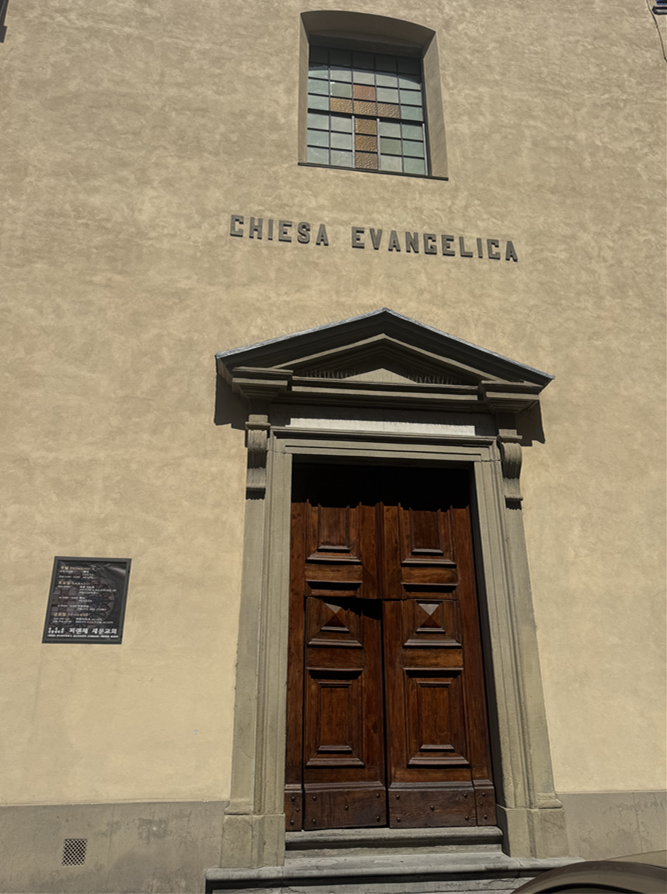
It is the Korean church in Florence, and on Sunday mornings the congregation inside sings in Korean, under a ceiling painted for Augustinian friars three hundred years ago.
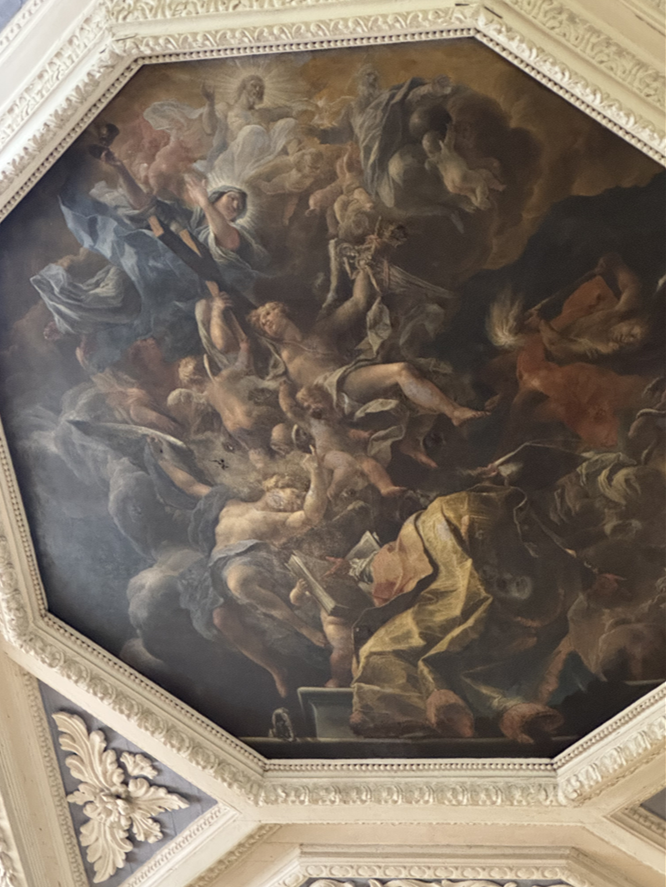
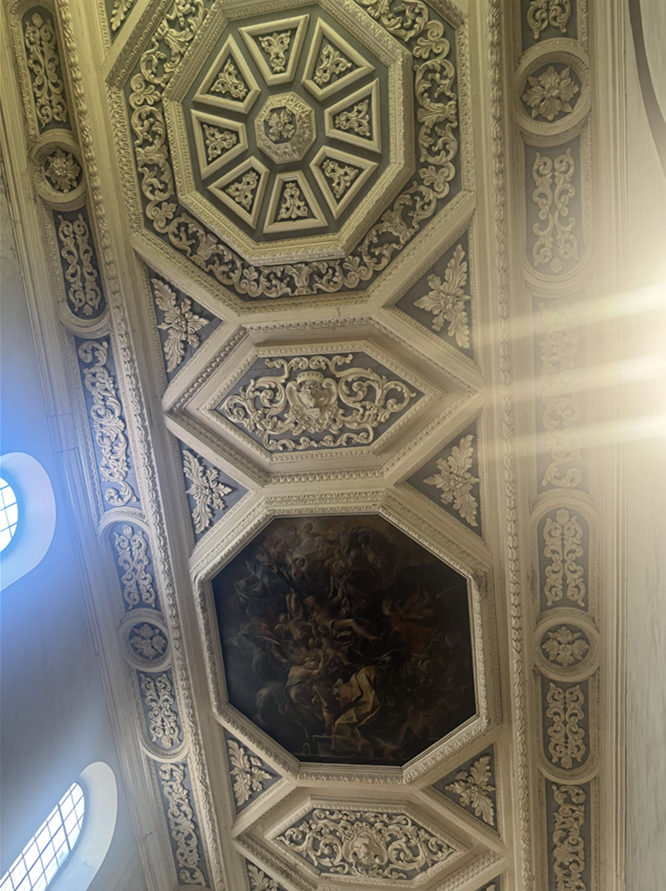
I started attending some months after moving to Florence, and it took me a while to look up. When I did, I stopped. The walls are bare, but the ceiling is dense with white stucco relief, and at its centre, framed in an octagon, hangs a large dark canvas. It is clearly very old. Nothing outside the building suggests it is there.
So I went looking for what this place used to be.
The church between the ditches
The original name is San Jacopo tra i Fossi — St James between the ditches. The ditches were the moat that ran along Florence’s second ring of walls, and the street outside was once called via della Fossa before it became Via dei Benci. Local tradition holds that the church was built partly from stone salvaged from the nearby Roman amphitheatre, which would make the material older than the building by a thousand years or so.
The church existed by the eleventh century. In 1170 a papal bull of Alexander III brought in Vallombrosan monks, who built a monastery alongside it. At some point in the late fourteenth century the entrance was turned around to face the street it faces today.
That is a fairly ordinary Florentine history. What happens next is not.
A monastery that moved house
Outside the city walls stood San Gallo, an Augustinian monastery. Lorenzo de’ Medici commissioned it as a public demonstration of Medici patronage, and the architect he chose was Giuliano Giamberti. As Vasari tells it, Lorenzo admired the result so much that he began calling him da Sangallo; when Giuliano joked that his real surname would be forgotten, Lorenzo replied that he was worthy of founding a new line under the new name. Other accounts are drier and hold that the family simply took the name from living near the Porta San Gallo. Either way the name stuck, and that is how architectural history knows them.
Then came the siege of 1529. Anything outside the walls could shelter the besieging army, so San Gallo was demolished — not by the imperial troops, but pre-emptively, by the Florentines themselves. Vasari, writing not long after, noted that nothing of it remained.
The Augustinians carried what they could inside the walls, and what they were given was San Jacopo tra i Fossi. Then they did something unusual: they rebuilt their old chapels in the new location, in their original form. Paintings by Andrea del Sarto came with them, including an Annunciation that would later lose a third of its surface to a flood while hanging here.
The transfer was formalised by papal decree on 6 April 1532. The pope was Clement VII — born Giulio de’ Medici, nephew of Lorenzo. The decree also included a house adjoining the church that belonged to the Medici family.
So: a Medici-funded monastery was destroyed, a Medici pope handed over a replacement, and the monks reassembled their old architecture inside it. The church was never Medici property, but a good deal of what the Medici built ended up walking through its door.
The ceiling I had been staring at dates from around 1690 — Alessandro Gherardini’s Ecstasy of St Augustine and the Triumph of Faith, painted for the Augustinians who by then had been here for a century and a half.
Emptied by decree
In 1808 the building was cleared out.
Not by war. Tuscany had been annexed to Napoleon’s French Empire the previous year, and in the spring of 1808 the suppression of religious houses was ordered across the region. Property and revenue went to the state, largely to service public debt. The previous government had closed around 150 religious houses over twenty-five years; the French closed roughly 450 in two.
The artworks scattered. The Fra Bartolomeo Pietà from the high altar is now in the Palatine Gallery. The building itself became a barracks. In 1849 the church lost its parish status altogether.
It is a strange thing to stand in. The building was not shelled or burned. It was emptied by paperwork.
The Scottish missionary
On 1 January 1874, a Scottish missionary named John R. MacDougall bought the whole complex and gave it to the Italian free church movement.
A stone plaque in the entrance passage still records it. His name appears there in Italian — Giovanni — alongside a note that the church had become a place of Protestant worship and that popular schools had been founded. Another plaque nearby, from 1898, marks the fourth centenary of Savonarola’s execution.
The detail I keep returning to is the schools. MacDougall did not simply rescue a building; he started something in it. And the building kept taking people in. From 1905 it housed an orphanage, and in 1909 it sheltered children orphaned by the Messina earthquake. That work eventually merged with the Istituto Gould and moved across the river in 1943.
The building passed to the Wesleyan Methodists in 1905 and, after the war, to the Italian Methodist Church. Today Italian Methodism is organised as OPCEMI, which has been in formal union with the Waldensian Church since 1975.
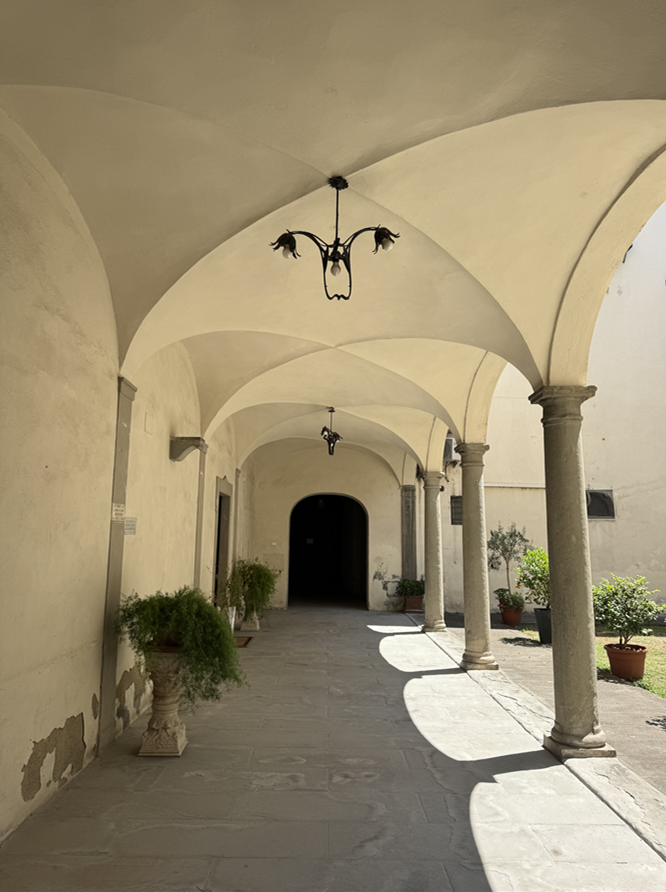
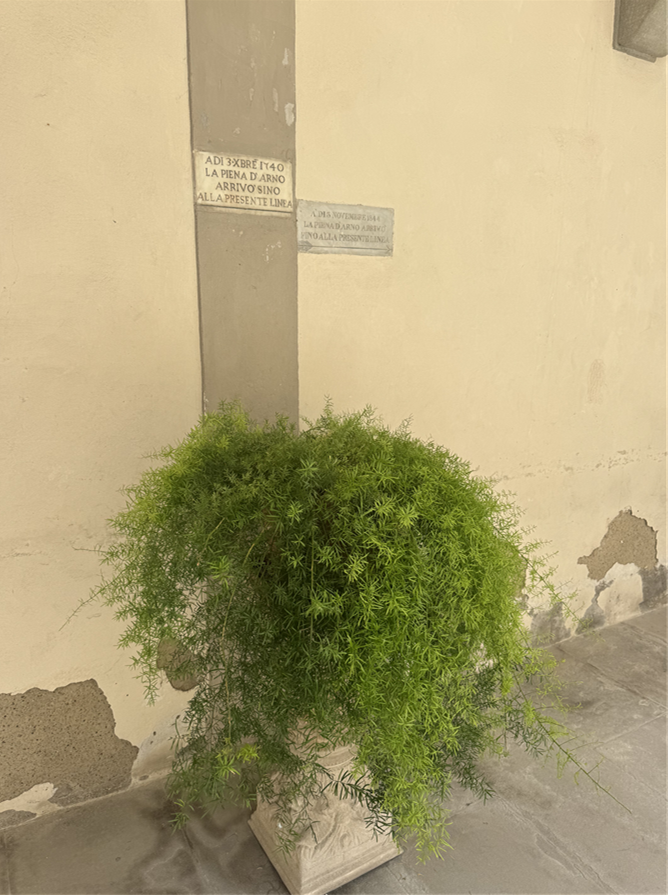
When the Arno flooded in 1966, this building — a short walk from the river — went under and needed years of restoration. In the cloister there are marble markers showing where the water reached in 1740 and again in 1844. I pass them most Sundays.
The long way round
There is a circle here that took two hundred and fifty years to close.
Methodism began in England with John Wesley, who wrote of an evening in 1738 when he heard Luther’s preface to Romans read aloud and felt his heart, in his phrase, strangely warmed. What followed was a movement that valued Scripture read alongside tradition, reason and experience, and that made a habit of preaching outdoors, to miners and labourers, in places the established church did not go.
It reached Korea in 1885, when Henry Appenzeller landed at Chemulpo — the port that is now Incheon — on Easter Sunday and founded Pai Chai Hakdang (배재학당, also romanised Paejae), one of the country’s first modern schools.
Presbyterian missionaries arrived at much the same time and built their own schools and hospitals. Within a generation these institutions had produced a disproportionate share of the people who would resist Japanese colonial rule.
The numbers are worth pausing on. Of the thirty-three signatories to the Korean Declaration of Independence in 1919, sixteen were Christians — nine Methodist, seven Presbyterian — alongside fifteen from the Cheondogyo movement and two Buddhists. Of the 19,525 people arrested in the crackdown that followed, 3,426 were Christians. That is 17.6 percent, from a population in which Christians made up under two percent. The arrest figures come from the Japanese colonial gendarmerie’s own survey at the end of 1919.
Nobody planned for that thread to run back to Europe. But it did.
Korean church in Florence, now
The congregation is called Saemun Church — 새문교회 in Korean.
About thirty years ago, its pastor arrived in Italy alongside a group of Koreans travelling to Carrara to study marble and stone carving — the same mountains Michelangelo climbed to choose his blocks. He had come to serve them.
The students eventually dispersed into academic and professional careers across Italy and elsewhere. The pastor stayed. And from around that time he and the small congregation that gathered around him began praying for a place of their own to worship.
They prayed for twenty-five years.
In 2021, in the wake of the pandemic, the Italian Methodist Church asked him to take on the use and care of this chapel. Five years on, a Korean pastor and congregation maintain the building and hold their services in it.
A little over a century ago, missionaries sailed from Britain and America to Korea and built schools, hospitals and churches there. The direction has reversed. Under a Baroque ceiling painted for Augustinian friars, in a building a Scottish missionary bought for the Italian Protestants, in a denomination founded by an Anglican priest in eighteenth-century England, the singing on Sunday is in Korean.
I do not know of another place quite like it.
What a Sunday looks like
I grew up Presbyterian and half expected a Methodist service to feel foreign. It does not. The Apostles’ Creed, hymns, a Scripture reading, a sermon, prayer — the shape is familiar.
One thing is different. At the offering, the congregation goes up one at a time. You walk to the front, pray for a moment, place your offering, and return to your seat. Where I used to worship, a basket passed along the pew while music played and I put something in without thinking about it much.
Which, thinking about it now, was a strange way to treat that part of the service. The offering is one of the few moments in worship where the congregation is not receiving but answering — a response to everything that has come before it. Doing it on your own feet, in your own time, makes that hard to miss. What had been a passage of the service became a minute that belonged to each person.
The pastor is explicit that the amount is not the point — that a child, or someone with nothing at all to give, can come forward and offer themselves and that is the whole of it. There is good scriptural ground for this. Christ sat opposite the treasury watching people give, and said the widow who put in two small coins had given more than anyone, because the others gave from their surplus and she gave everything she had. Paul writes that the gift is acceptable according to what a person has, not what they do not have.
What it looks like, oddly, is the thing you see in any old Italian church: someone lighting a candle and standing quietly for a moment before moving on.
I later learned that the pastor studied liturgy formally, which explained a good deal — why every part of the service has a clear place, why nothing runs over and nothing feels thin. The service does not sit awkwardly inside this very old room. The preaching is of a piece with that: careful with the text, densely argued, and built rather than improvised.
There is a lot of prayer here, before the service and after it. People stay in their seats afterwards and pray for a long time. Immigrant life gives you plenty to pray about — visas, work, children caught between two languages, parents growing old on the other side of the world. Sitting among people praying like that, it is difficult not to think that things will be led somewhere sensible, even when nobody in the room can see how.
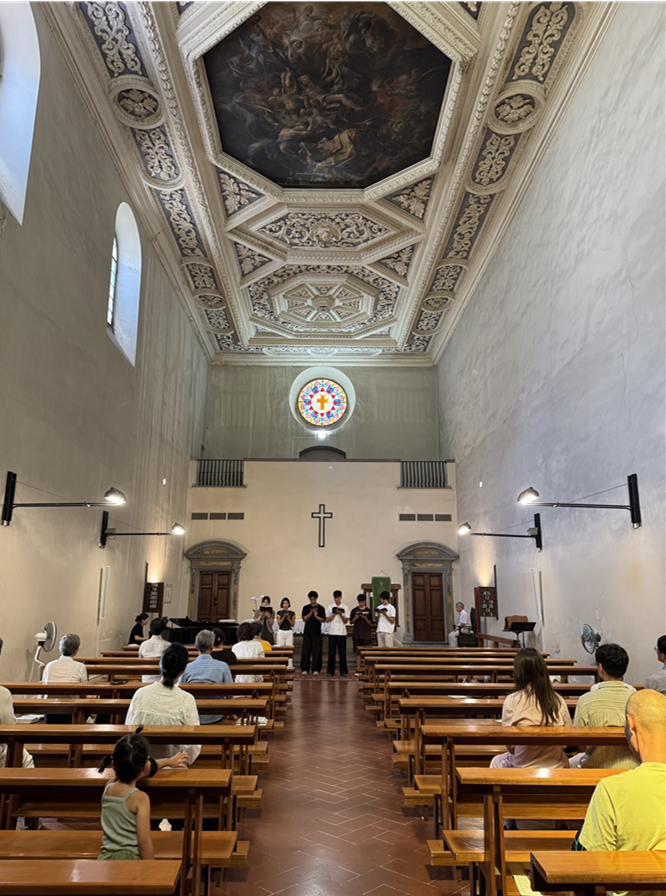
At the end of the service the pastor greets each person individually, newcomers included, and invites them to stay for lunch.
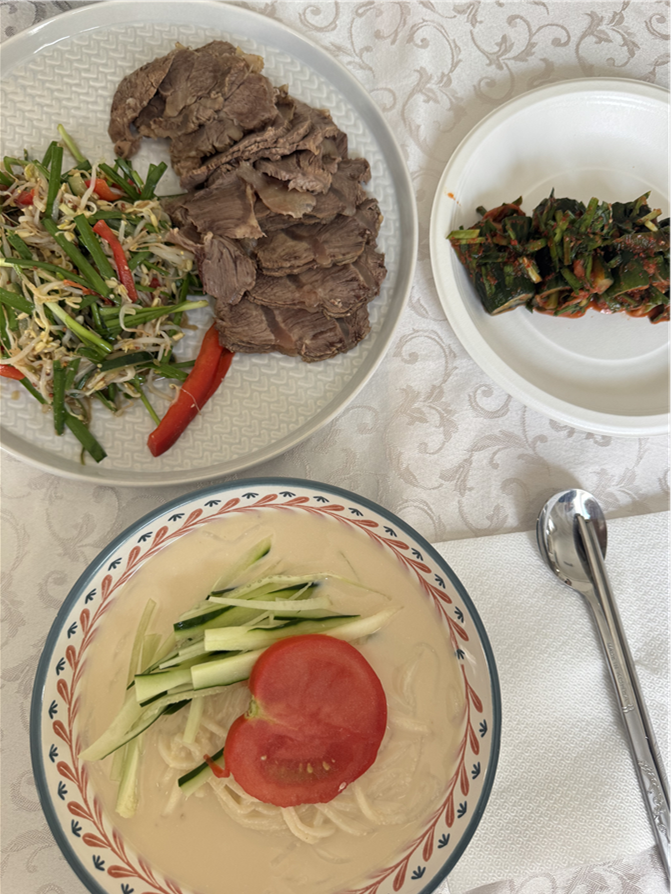
The lunch is not a token. The senior women of the congregation cook it themselves, and they produce Korean dishes that are increasingly hard to find even in Korea — which, given how difficult some of the ingredients are to source in Tuscany, represents a weekly effort you can taste.
There are a good number of second-generation Korean-Italians here too. Children born and raised in Italy, singing the hymns in their parents’ language. Whatever this congregation is, it is not going to end with one generation.
Visiting
The service is in Korean, but visitors are welcome regardless of language. If you are in Florence on a Sunday and want to see that ceiling — or you are a Korean speaker passing through — you can simply walk in. Come for the lunch as well; you will be asked anyway.
Nobody who has held this building has held it for long. The Vallombrosans, the Augustinians, the soldiers billeted here under Napoleon, the orphanage children, MacDougall himself — none of them were the last. Whoever is here now is one line in a very long list.
Which is, I think, the right way to hold it. Twenty-five years of prayer produced not a possession but a responsibility. The stone will outlast us, as it outlasted everyone before. What I would rather leave behind is the other kind of trace: that when Koreans were here, they preached and looked after their neighbours, and did it well enough that someone a long time from now might notice.
A longer version of this account, written in Korean, is on my blog: 피렌체 한인교회 새문교회 — 천 년을 지나온 예배당
Saemun Church (새문교회)
Chiesa Coreana di Firenze – Saemun
Korean Methodist Church (기독교대한감리회)
Address: Via dei Benci 9r, 50122 Florence, Italy
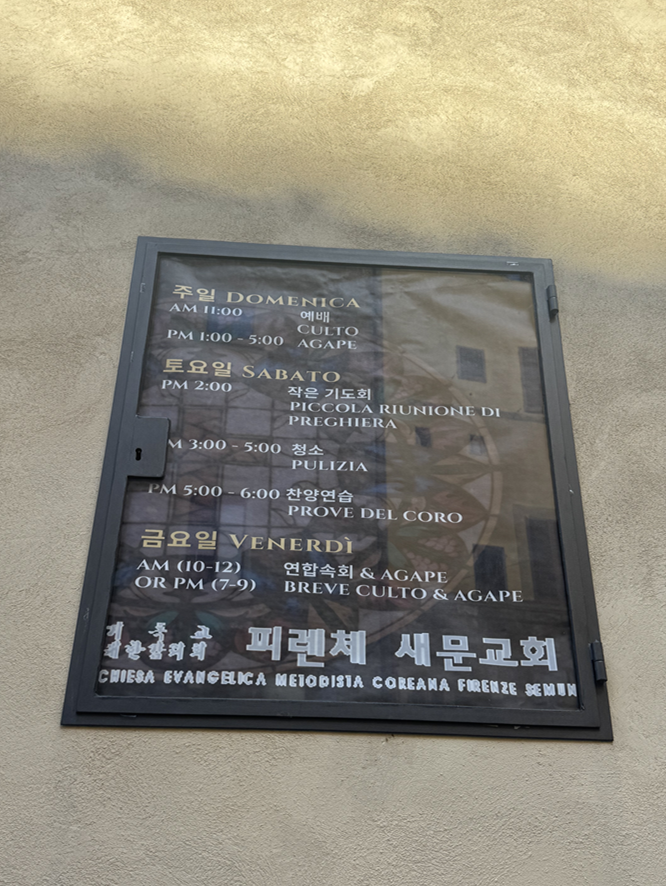
Sunday service: 11:00 (in Korean)
Getting there: about a 3-minute walk from Piazza Santa Croce, towards the Arno
The building is the former church of San Jacopo tra i Fossi. Look for the words CHIESA EVANGELICA on the facade.
Note: this is Saemun Church specifically — there is more than one Korean congregation in Florence, and the names are easy to confuse.
피렌체 한인교회 중 한 곳인 피렌체 새문교회입니다.
이탈리아 피렌체 소재 한인교회 | 기독교대한감리회 소속
주일예배 오전 11시 · Via dei Benci 9r, 50122 Firenze
산타 크로체 광장에서 아르노강 쪽으로 도보 약 3분