
This article is a condensed version of the subscriber research published on 14 August 2026. The valuation figures and coordinates are available in the original.
Buongiorno.
After my last deep dive I sat down to check a single toxin name in my Korean Beauty coverage, and found that eight of my seeds — the individual companies I hold inside a given field — had all reported within one week. So I walked the whole field again. Two American beauty names reported in the same stretch, which finally lets me fill the seat I left empty in my consumer deep dive.
Read the report cards alone and the season looks uniformly good. Open them up, and what happened inside each name splits.
Three questions, then. What turned up when I took a good report card apart? Which seeds had the wind draw noticeably closer this season? And where was I wrong in my earlier work?
1. An Even Season, Four Endings
The season was remarkably even. Kolmar Korea (161890 KS) posted a record quarter with operating profit up 50%. Dalba Global (483650 KS) beat consensus by double digits. Pharma Research (214450 KQ), APR (278470 KS) and Pumtech Korea (251970 KQ) all printed record results. Outside my coverage, Cosmax and Cosmecca Korea did the same. Among the eight seeds I track, only Medytox (086900 KQ) saw profit move backwards.
And yet the same surprise meant four different things underneath. Names where the engine sat somewhere other than the surface suggested. Names where a bottleneck that had pressed on earnings for several quarters finally cleared. Names where the market had already finished answering. And names where the yardstick used to measure the company changed.
Same field, same rain, different circumstances. I’ll walk them in order of where each one stands in the supply chain.
2. Seeds on the Shelf
Amorepacific: A Question That Began at a Sephora Counter
My first Korean Beauty deep dive in April opened in a Sephora in Florence. An AeSTura cream sat mid-shelf with a bestseller tag, and I watched a local shopper deliberate between it and Beauty of Joseon before choosing AeSTura, because it was a derma brand. The question I asked then: has Amorepacific (090430 KS), trying to restart in the West after years of Chinese dependence, actually entered a window where it can be re-rated?
The second quarter answered in profit for the first time. Operating profit rose nearly 60%, and the engine was not a Chinese recovery but a change of market. North America grew nearly 30% behind derma and Laneige. Europe grew more than 40%, with Sephora joined by a UK Boots entry. The counters I described in April as still at initial-order stage began returning revenue within a single season.
China remains in decline but held its profit, and an improving cost ratio kept the operating margin in double digits for a second straight quarter. That suggests a changing cost structure rather than one lucky quarter. I’d call this the quarter in which April’s expectation began to take physical form. So I’ve changed how I look at this company — from confirming a recovery to asking whether profit growth has taken hold.
The risks, stated plainly. Management acknowledged that much of the US and European growth is driven by Amazon and TikTok Shop promotions. Q3, without Prime Day, is the first test of that dependency. And there is the September investor day: not an earnings release, but a presentation of mid-term roadmaps for derma and hair care.
Dalba Global
The cleanest beat of the season, ahead of consensus by double digits. North America grew 174%, which may be the most direct evidence yet that Korean brands are taking shelf space in US mass beauty.
What changed here, though, was not the company but the yardstick used to measure it. Re-measuring where peers actually trade reset the standard, and expectations came down even as earnings went up. Whether next quarter’s margin converges to company guidance or beats it, as recent form suggests, sets the direction from here.
APR
Two consecutive quarters of beats lifted earnings estimates 66%, and a stock that had gone sideways rose 12% in eight sessions to catch up. The stretch where earnings outran the price closed quickly. I’ll add that I still find it difficult to view APR as my preferred name in Korean Beauty.
3. Seeds on the Manufacturing Side
Kolmar Korea
A record quarter with operating profit up 50%. The market answered within a day, as sixteen houses raised their targets, and the stock rose 37% in six weeks.
The speed of that response is the part worth recording. A scenario in which earnings upgrades and multiple expansion happen together already appears to be in the price. This was my preferred name in the April deep dive — but excellent results proving the thesis, and those results already being paid for, are two different statements.
Pumtech: The Bottleneck Clears
What happened here was a bottleneck clearing. In my July work I described this company as held back by a delayed ramp at its fourth plant. The problem was never demand; it was supply. Orders had been outrunning production, backlog had accumulated, and raw material costs sat on top.
In the second quarter the knot came undone. New capacity began absorbing volume, and price increases took full effect from June — a roughly 20% increase that orders absorbed without flinching. When you can raise prices and the orders keep coming, you hold the bottleneck. Net profit attributable to controlling interests rose nearly 60%.
And this looks like the first step rather than the whole staircase. The sixth plant completes in Q3 and starts operating in Q4, opening pharmaceutical and health-supplement packaging as new categories. The seventh breaks ground in September. The vessels to absorb that backlog arrive in sequence.
4. Seeds in Toxin and Aesthetics
Hugel: Taking a Good Report Card Apart
The facts first. Hugel (145020 KQ) reported second-quarter revenue of KRW 137.9bn, operating profit of KRW 56.0bn and a 40.6% operating margin. Holding a 40% margin while SG&A grew more than 60%, during a period of heavy US direct-sales investment, is the detail worth pausing on. The margin trough is also behind us: non-commercial batch production costs concluded in Q2, putting the 76.7% gross margin at the floor, with a return toward 78% the normal path from Q3.
Then I opened the regional breakdown, and found something I had glossed over in my earlier work. The engine behind the Q2 beat was not the United States. Roughly two-thirds of the sequential increase came from APAC, and within that, China. The Americas added only modestly and remain well below their Q4 2025 peak.
In other words, the United States hasn’t started yet. That cuts both ways. This beat happened without any US contribution. At the same time, the central pillar of my argument — US operating leverage — remains unverified in the numbers.
Three Engines, Three Different Clocks
Having laid the disclosures and call commentary along a timeline, I have to correct myself: my clock was set at too low a resolution. This company’s growth story is not one engine but three, and they run on different schedules.
US direct sales is the main body of the story. First sales began in June, but revenue contribution through that window is minimal, and what management described on the call as an explosion in revenue arrives at the one-year mark of direct sales, in the second half of 2027. The 2028 guidance of KRW 900bn in revenue and 10% US market share is the destination.
China is the current cash cow. It drove the Q2 beat, but partner restocking has concluded and shipments return to a regular ordering cadence in the second half.
Cosmetics and skin boosters begin domestic sales in Q3, but meaningful contribution belongs to next year.
Overlay the three clocks and the window from Q3 2026 through Q1 2027 is a gap between the story and the earnings. China decelerates, the US isn’t yet material, and SG&A keeps climbing. It is the stretch in which skepticism about the story is easiest to voice, and the first genuinely good news in the numbers may not arrive until the first half of 2027.
So the story is ripening on schedule. FDA approval, 3% share through distribution, direct-sales leadership in place, first June sales — not one checkpoint has been missed. What became clear this quarter is that the harvest sits further out than I had thought. More certain, and further away.
Medytox
The only one of the eight seeds where profit moved backwards. It is also where my own thesis was rejected by the numbers: I had built the case on legal costs normalizing once one-off litigation expense passed, and the semi-annual report showed those costs holding.
The move, if it comes, is large — but the company doesn’t get to decide when the wind blows. The remaining paths, a September US filing and a verdict, are conditional on both timing and outcome. The clock here is held by the court, not the company. Which stands in direct contrast to Hugel, turning its own clock by hand.
Pharma Research
Another record quarter. Q3, though, is worth flagging: it combines an inbound-treatment low season the company itself identified, an Eastern European order gap, and losses from a newly consolidated entity. Consensus does not yet appear to reflect all of that.
I had a correction of my own here. I treated Q2 advertising spend as one-off before the company’s annual plan revealed it as structural. This may be the quarter where the distance between a good company and a good entry point becomes visible.
5. The View From the US Side
For readers who follow the American names more closely than the Korean ones, this is the section that matters most this quarter.
e.l.f. Beauty
In my consumer deep dive I mapped a splintering consumer landscape and placed Estée Lauder (EL US) and e.l.f. Beauty (ELF US) side by side as the symbols of prestige giving way to value. I wrote then that Korean Beauty’s growth in the US sits on exactly that current. What I never did was calculate where either symbol stood. Both had news this week, so let me set them alongside our seeds.
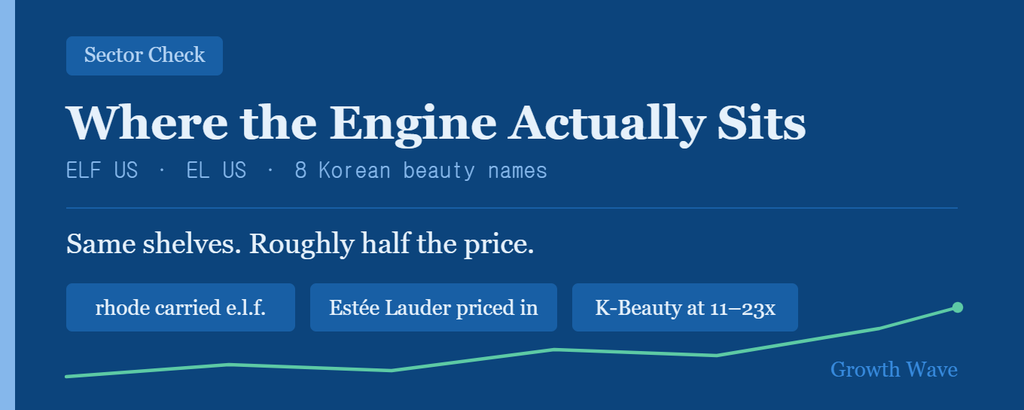
The quarter looked good. Open it up, though, and the owner of the growth has changed. rhode, acquired last year, delivered a third of quarterly revenue, while the core e.l.f. business declined at a high-single-digit rate with volume down three percentage points. The company is defending volume through price cuts, and the USD 50m in tariff refunds it received will be reinvested entirely into marketing and selective price reductions.
The company once called the winner of the value shift is becoming one that buys winning brands to fill its growth. Where the engine actually sits, inside a good report card, is something you have to check separately — regardless of which side of the ocean you’re on.
That fact cuts both ways for us. If US mass beauty demand hasn’t cooled but simply has more options, Korean brands are on that list. Dalba’s 174% North American growth and Amorepacific’s 30% may be the evidence. Asking where e.l.f.’s lost volume went is precisely why this company belongs inside a Korean Beauty check.
Estée Lauder
The opposite story. Its restructuring program is on track, with adjusted operating margin recovering to 15% last quarter and the bulk of the savings landing next fiscal year. Prestige appears to be passing its trough.
When I wrote the original piece, the 19 August release was still ahead. I expected no surprise from it. Consensus earnings estimates already sat above the top of the company’s own margin target, and this is a company with a history of guiding conservatively at the start of a year.
The result went against me. Both companies beat consensus, and both shares rose sharply after reporting. e.l.f. and Estée Lauder moved in the same direction, which is not what the two sets of underlying numbers would have suggested. One is filling a hole in its core with an acquired brand. The other has not yet banked the savings it is promising. They were rewarded together anyway.
That reaction is worth examining on its own. Either the way the market looks at the beauty sector has changed, ahead of what individual results justify, or each company’s specific situation was recognized on its merits. It is too early to answer, but this is not a signal to walk past. It may be the reason to watch the beauty sector over a longer horizon rather than as a passing rotation.
Set the two next to our seeds and one thing remains. They compete for the same shoppers on the same shelves, yet the standard used to price them still differs by continent. Growth quality and brand history differ, so that alone doesn’t establish undervaluation. But the fact that this distance hasn’t narrowed while Korean cosmetics exports set a first-half record is worth writing down.
Closing
Two things stood out on the walk.
Most of this season’s surprises were built differently from the surface everyone was reading. Amorepacific was pulled by the West, not China. Hugel was pulled by China, not the US. e.l.f. was pulled by an acquired brand, not its core.
And the shift from prestige to value is a current I read first in the US. The open space left by that current, though, appears to be larger in Korea. The products are selling; the valuation hasn’t followed.
Every seed runs on its own clock, so here are the dates I’ve marked. End of August, the Pumtech semi-annual report. September, the Amorepacific investor day, the Medytox US filing, and e.l.f.’s rhode launch across 19 European markets. Early to mid November, third-quarter earnings season: Hugel’s first direct-sales P&L, Dalba’s margin direction, Pharma Research through its low season, and e.l.f.’s first read on the European launch. February 2027, Hugel’s 2027 guidance.
The result of this season is clear enough. Everyone posted good numbers, and the wind has started moving through the field. Two mistakes come easily at moments like this: digging up a seed that is still ripening, and reaching for the scythe simply because the wind picked up.
I intend to do neither. The ripening seeds get time; the seeds where a checkpoint is close get their dates set out in front of them. To borrow Kostolany’s language, this is a stretch for holding the ground of the strong-nerved while the hesitant make noise.
If you want to see where the eight names ended up — the coordinates, meaning my fair-value bands and where each price currently sits against them — the full research is linked in my profile. For the structure, this article is enough.
I’ll report back on the next date.
Ciao. 🌱
🌱 Growth Wave · Full Deep Dive
Where the Engine Actually Sits: e.l.f., Estée Lauder, and Eight Korean Beauty Names
The article above is a condensed version. Subscribers get the full research: every valuation figure, and the map of where all ten names sit.
This newsletter is for informational purposes only and does not constitute investment advice or a recommendation to buy or sell any security. The author may hold positions in the securities discussed. Do your own research and consider your own circumstances before investing.