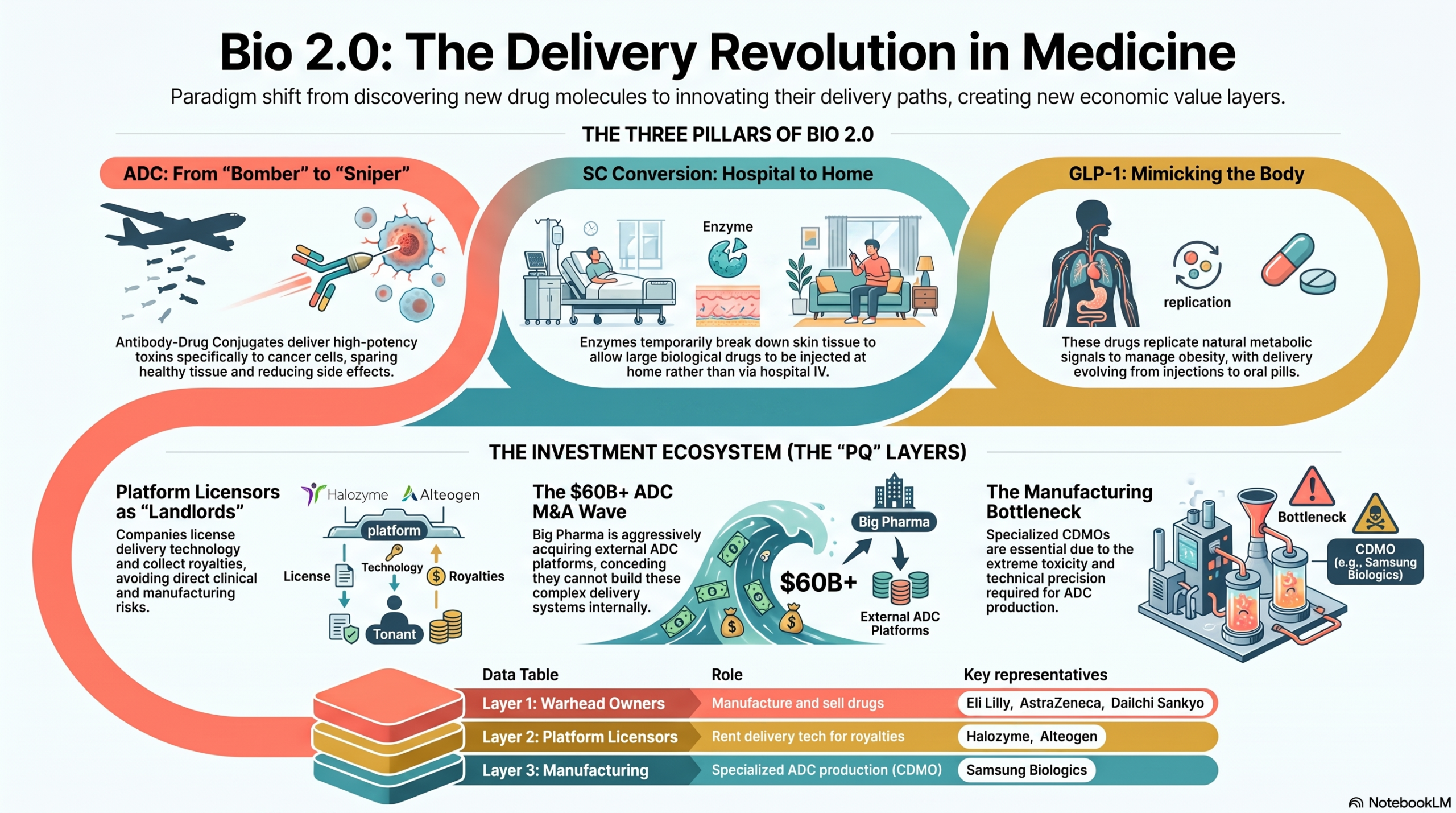
This article is a condensed version of the subscriber deep dive published on June 29, 2026. The report was written with a market correction in mind, and a month on, its top pick has moved against the index and set an all-time high this past Friday. We are archiving the article here as well. Specific figures and valuation coordinates are available in the original.
Introduction
Bio 2.0 has been on our Mega Wave map for some time. We described it as a delivery revolution: a change not in what the drug contains, but in how it reaches the body. FDA-approved ADCs have surpassed fifteen. The subcutaneous conversion platform is accelerating. Eli Lilly has bet $5 billion on manufacturing capacity.
And yet we never went deep.
While our attention was on AI infrastructure — memory, optical interconnects, power equipment — Bio 2.0 sat on the map without being properly examined. Biotech felt harder. The terminology was unfamiliar, a single clinical readout could cut a stock in half, and it was never obvious where to start. It was easy to keep moving.
Then something shifted. The July calendar was crowded with the SK hynix ADR listing and the preliminary results from Samsung Electronics and SK hynix. Once those are absorbed, the remaining runway in the memory cycle becomes legible. The question that follows is where the capital goes next.
We spent several days working through that question. Most sectors were already carrying the valuation they deserved. Front-end semiconductor equipment, which parts of the market had been framing through the Q-cycle argument, did not clear our bar. Materials and components remain attractive and remain our focus in the Korean market, but the object of this particular search was different. Two markets held our attention, for different reasons.
In Korea, power equipment. A stronger dollar supports upward revisions to export earnings, and while the sector has corrected, the earnings themselves have not been affected. The largest bottleneck in the chain is still unresolved there. We have already lived through one stretch where the market’s enthusiasm for that sector ran well past the fundamentals, and if the correction runs deep enough, it is a field worth returning to.
In the United States, biotech. We laid out the US sector map and looked for growth that was visible in the numbers but not yet in the attention. One sector kept appearing. Bio 2.0, the theme we had already placed on the Mega Wave map. It seemed time to look at it properly.
Chapter 1 — Two Directions of Revolution
Look back across the history of medicine and revolutions arrive in one of two forms.
The first is discovering a stronger molecule. Penicillin found a way to kill bacteria. Statins found a way to block cholesterol synthesis. Checkpoint inhibitors found a way to stop cancer from hiding from the immune system. In each case the breakthrough was a new target and a new molecule to hit it.
The second is delivering an existing molecule more precisely. The mechanism is already understood, but something goes wrong in transit. The drug reaches the wrong tissue, the side effects are too severe, the patient has to visit a hospital every two weeks and eventually stops showing up. The breakthrough here is not a new molecule. It is a redesigned path.
The revolution happening now is the second kind.
ADC solves the problem of delivering a cytotoxin only to cancer cells. Subcutaneous conversion solves the problem of delivering large biologics outside of hospital infusion rooms. GLP-1 solves the problem of mimicking a metabolic hormone signal precisely enough to sustain its effect over days rather than minutes.
Three different diseases. One direction: redesigning how molecules move inside the body.

This is why Bio 2.0 belongs on the Mega Wave map. It is not one new drug. It is a paradigm shift in how drugs are built, and when paradigms shift, entirely new positions for capturing price and volume are created.
The next three chapters examine each revolution in turn.
Chapter 2 — Building the Sniper
Cancer treatment has faced the same problem for decades.
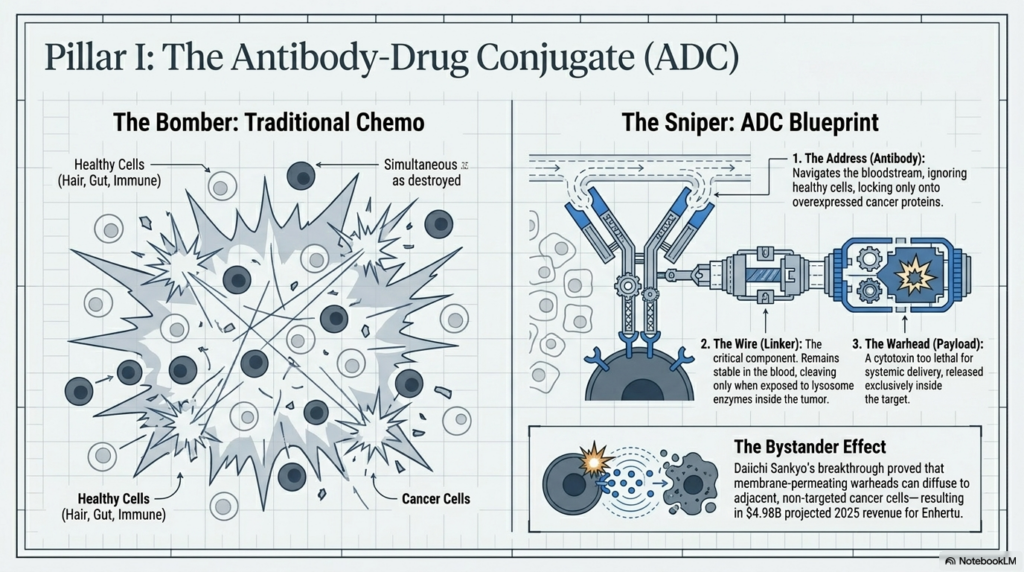
When you introduce a cytotoxin into the bloodstream, it does not only kill cancer cells. It circulates through the body and attacks any rapidly dividing cell it encounters. Hair follicle cells divide rapidly. So do the cells lining the gut. So do immune cells. The hair loss, the nausea, and the immune suppression that define chemotherapy are the direct consequence of a drug that cannot tell a cancer cell from a healthy one.
Lower the dose and you lose efficacy. Raise it and you raise toxicity. It is a bomb dropped on a city block to hit a single target.
The idea that followed was the antibody.
Antibodies are proteins the immune system produces naturally. They work like a lock and key, each one recognizing a specific target protein and binding to it. Cancer cells tend to overexpress certain surface proteins that healthy cells do not, and an antibody can be engineered to treat those proteins as an address.
The concept followed. Attach a cytotoxin to the antibody, let the antibody find the cancer cell and bind to it, and only then release the drug. A sniper instead of a bomber. That is the origin of the ADC — the antibody-drug conjugate.
The structure has three components. The antibody is the address recognition system. The payload is the warhead — a toxin so potent it cannot be administered directly to a human being. The linker is the wire connecting them, stable in the bloodstream and designed to break only once inside the target cell.
The idea was right. The wire was the problem.
The first ADC received FDA approval in 2000. It was withdrawn from the market a decade later. The linker had been cleaving prematurely in the bloodstream, releasing the payload before it reached its target, which left the drug functionally no different from conventional chemotherapy. Between 2000 and 2019 the FDA approved just four ADCs.
The turning point came from Japan, in 2019, from Daiichi Sankyo.
The drug was Enhertu. In a trial targeting HER2-positive breast cancer it nearly doubled survival time compared with existing treatments. The linker had been redesigned to remain stable in circulation and break only in response to a specific enzyme released inside lysosomes, the cell’s internal digestive compartment. The wire now cut in exactly the right place.
Then something else emerged. Enhertu’s warhead, DXd, has membrane-permeating properties. Released inside a cancer cell, it diffuses through the cell wall and kills adjacent cancer cells, including those the antibody never recognized. One shot, penetrating the target and taking out what stands behind it. This is the Bystander Effect, and it matters because real tumors are heterogeneous. Not every cell expresses the target protein. Earlier ADCs missed those cells.
One redesigned linker changed the trajectory of the entire field. Enhertu expanded from breast cancer into gastric and lung cancer, and its 2025 revenue reached $4.98 billion, the highest of any ADC on the market.
The signal it sent was unmistakable. Pfizer acquired Seagen for $43 billion. AbbVie acquired ImmunoGen for $10.1 billion. Gilead acquired Tubulis for up to $5 billion. Eli Lilly made three separate ADC acquisitions in 2026 alone. Total ADC-related M&A since 2023 exceeds $60 billion.
The numbers say one thing. Big Pharma has conceded that it cannot build ADC capability internally. The platform lives outside the building, and it has to be bought.
If ADC is the first expression of the delivery revolution, the second is happening more quietly, and across a much wider surface.
Chapter 3 — The Injection You Take at Home
Look closely at ADC clinical data and one limitation repeats across every program.
They are all intravenous.
An IV infusion means going to a hospital, sitting for thirty minutes to several hours, and doing it again every one to two weeks. For a patient in active cancer treatment that is a meaningful burden on quality of life. A significant share of treatment discontinuation has nothing to do with efficacy. It is the logistics of the infusion schedule.
Subcutaneous injection changes the equation. A needle into the fatty tissue just below the skin, deliverable at home or at a primary care clinic, the same way a diabetic patient self-administers insulin.
There is a structural obstacle. Insulin is a small molecule and moves easily from subcutaneous tissue into the bloodstream. Biologics are orders of magnitude larger, and the dense matrix of subcutaneous tissue blocks their movement. Think of a narrow alley that a large truck cannot enter. The drug either is not absorbed, or absorbs too slowly to reach therapeutic levels.
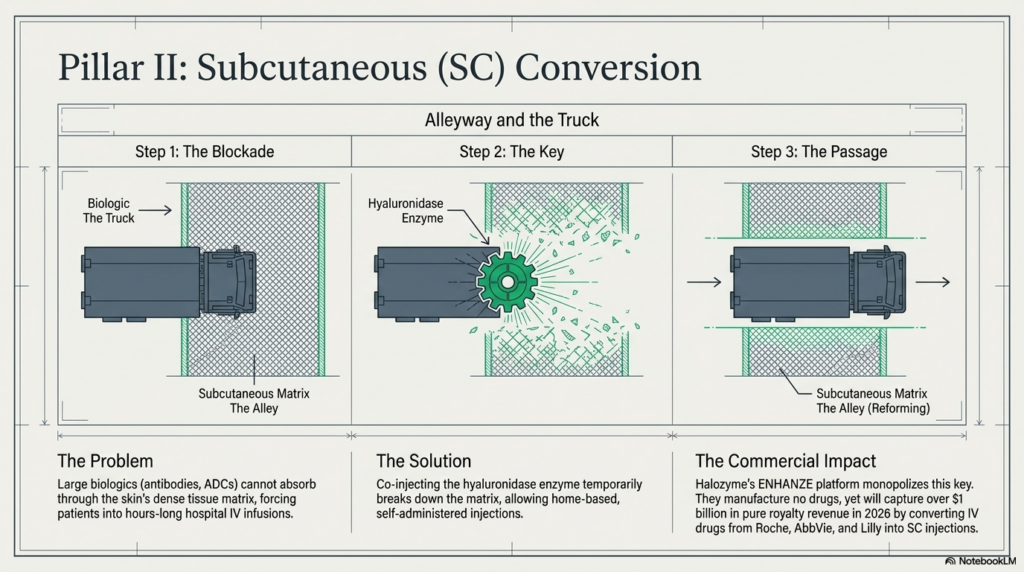
The solution is an enzyme. Hyaluronidase temporarily breaks down the subcutaneous matrix, creating space for large molecules to pass through. The alley wall is briefly removed to let the truck through, then restored. Co-inject the enzyme with the biologic and a drug that previously required IV infusion can be converted to subcutaneous delivery.
Halozyme (HALO US) built a platform around this enzyme, called ENHANZE. Halozyme does not make drugs. It licenses the enzyme technology to pharmaceutical companies and collects royalties on the resulting sales. The partner list reflects the platform’s leverage: Roche, Janssen, AbbVie, Eli Lilly, BMS, argenx. Cancer therapeutics, autoimmune treatments, and HIV drugs are all converting through the same platform. Total 2025 revenue reached $1.4 billion, up 38% year over year.
The opportunity does not stop with one company. The fastest-growing category of drugs already delivered subcutaneously is GLP-1, and the delivery format for GLP-1 is now evolving again.
Chapter 4 — Mimicking the Hormone
Obesity has long been framed as a failure of discipline.
Eat less, move more. The logic is simple. The biology is not. The body maintains a set point for weight and responds to caloric restriction by raising appetite and lowering metabolic rate. Willpower is fighting a physiological system, and the system usually wins.
GLP-1 changes the signal itself.
GLP-1, or Glucagon-Like Peptide-1, is a hormone the body produces naturally after eating. Released from the small intestine, it signals the pancreas to secrete insulin, slows gastric emptying, and transmits satiety signals to the brain. It is the hormone responsible for the sensation of fullness after a meal. Its half-life is measured in minutes, which is far too short for therapeutic use.
GLP-1 receptor agonists replicate that function in a modified molecular form that resists degradation. The drug binds the same receptors and sends the same signals, but persists for days. One subcutaneous injection per week maintains satiety signaling continuously.
The clinical results restructured the market. Eli Lilly’s Zepbound produced average body weight reductions of 22% in trials, more than twice the effect of any prior obesity drug. A therapy developed for diabetes had revealed a magnitude of weight loss that existing treatments could not approach, and cardiovascular protection, kidney function, and heart failure management followed as additional indications.
GLP-1 revenue for Eli Lilly reached approximately $13 billion in 2024 and surpassed $20 billion in 2025. Combined with Novo Nordisk’s Ozempic and Wegovy, the global market is approaching $40 billion annually.
Now the delivery format is evolving again. Lilly’s orforglipron — a once-daily oral GLP-1 — received FDA approval in April 2026, with European and Asian launches scheduled from the second half of 2026 through early 2027.
This is also where SC conversion and GLP-1 converge. As next-generation GLP-1 therapies move toward higher concentrations and longer durations, subcutaneous absorption becomes a critical variable. Halozyme’s acquisitions of Elektrofi and Surf Bio, consolidated into the Hypercon platform, target exactly this problem. The next generation of GLP-1 products may be built on that infrastructure.
Three chapters, three expressions of the same revolution. ADC delivers cytotoxins only to the cancer cell’s address. SC conversion moves hospital infusions into the home. GLP-1 mimics a metabolic signal precisely enough to alter body weight at a systemic level. Each redesigns how a molecule moves inside the body.
Now the question is where the price and volume opportunity sits within that structure.
Chapter 5 — Where the PQ Opportunity Lives
The delivery revolution creates the question that follows every structural shift in an industry. Who actually captures the economic value?
The companies making the drugs are the obvious answer, and in this case not the only one. The companies licensing the delivery technology, operating the manufacturing infrastructure, and owning the platform receive meaningfully different forms of the same tailwind. The shape of the opportunity depends on which layer you are looking at.
Layer 1 — Warhead Owners
These companies manufacture and sell the drugs directly. Price is the list price. Volume is the number of patients treated. Every new indication added to an approved ADC multiplies the eligible pool.
The structural advantage of this layer is pricing durability. Once a drug establishes itself as standard of care it retains pricing power until a direct competitor emerges, and ADC manufacturing is complex enough that biosimilar replication after patent expiry is difficult. The winner in a given tumor type tends to hold its position.
Eli Lilly (LLY US) occupies the widest position in this layer. GLP-1 revenues generate a cash flow base that funds aggressive ADC acquisition, and Lilly is the only major pharmaceutical company operating on both axes of the delivery revolution at once. The more interesting bet may be the one inside its own franchise. Only 20 to 30% of eligible GLP-1 patients currently initiate treatment, and the primary barrier is injection aversion. An oral format removes that barrier. Lilly buys the delivery revolution in ADC and builds it in GLP-1.
AstraZeneca (AZN US) co-developed Enhertu and Datroway with Daiichi Sankyo and leads the commercial partnership, with more than six additional ADC candidates in clinical development. Enhertu’s expansion into early-stage breast cancer is the near-term volume driver, since patient counts in early lines are substantially larger than in late-stage disease.
Daiichi Sankyo (4568 JP) holds what is currently the most capable ADC platform in operation. The DXd linker-payload system underlies Enhertu, Datroway, and a pipeline of further candidates. In FY2025 the company recorded approximately KRW 950 billion in special losses from overinvestment in ADC manufacturing capacity. Even the strongest platform owner can misjudge demand. Platform strength and execution accuracy appear to be separate variables.
Gilead Sciences (GILD US) is pivoting from HIV into oncology. Trodelvy provides an existing ADC position and the Tubulis acquisition adds pipeline. The pace at which the pivot converts into revenue is the variable to watch. Pfizer (PFE US) entered the market at scale through Seagen and now carries ADC revenue among the largest in the industry. Buying scale and operating it are different problems, and the integration is what the market is watching.
Genmab (GMAB US) sits at the boundary of Layer 1 and Layer 4. Darzalex is a fully commercialized asset generating several billion dollars annually, and the ProfoundBio acquisition adds ADC pipeline exposure. Darzalex patent expiry is concentrated in 2029 to 2032. Whether the pipeline can replace what that royalty stream eventually loses is effectively the only question this company presents.
Layer 2 — Platform Licensors
These companies do not manufacture drugs. They license the delivery technology and collect royalties on what their partners sell. Clinical risk is borne elsewhere, and revenue grows as the partner’s drug grows.
The structural advantage here is scalability. The asset is not one drug but the platform itself. Each new partner, each new indication, each new approved product adds to the royalty stream without proportional cost.
Halozyme (HALO US) is in an effectively monopolistic position within subcutaneous conversion. ENHANZE has thirteen partners and ten approved products. The company manufactures nothing.
The market prices this company for one reason: ENHANZE core patent expiry in 2027. Three countervailing factors deserve consideration.
First, the 2025 acquisitions of Elektrofi and Surf Bio added co-formulation patents. A biosimilar attempting to replicate the same formulation and route must navigate those additional layers. The expiry of a single patent does not dismantle the moat.
Second, the Darzalex SC royalty, from Janssen’s multiple myeloma franchise, runs contractually through 2032. The largest revenue source in the portfolio continues for five years past the core patent date.
Third, the Hypercon platform is positioned as the second-generation engine, with next-generation GLP-1 and ADC formulations as potential candidates from the 2030s. If ENHANZE is the first engine, Hypercon is the second.
One line about patent expiry against three layers of defense. Which of the two is the market actually looking at? Whether 2027 marks the end of this company or the start of its next chapter is the most important question in this layer.
Alteogen (196170 KS) runs the same SC royalty model at a different point in the lifecycle. Where Halozyme is a mature royalty cash flow, Alteogen is in the initial ramp. Its MSD partnership for Keytruda SC has entered global clinical validation, with sales milestone recognition expected to begin in the second half of 2026. Two companies in the same structural layer at different maturities is the anchor for reading this position.
Layer 3 — Manufacturing Infrastructure (CDMO)
ADC manufacturing is substantially more difficult than conventional biologic production. Payloads are highly cytotoxic and dangerous to operators if released during processing. Dedicated containment facilities, negative-pressure environments, and specialized protective equipment are required. Conjugation, the process of attaching payload to antibody at a precise ratio, demands a consistency few facilities can deliver.
The BIOSECURE Act, enacted in the United States in 2024, restricted contracting with Chinese CDMOs. Volume directed toward WuXi XDC and comparable facilities began redistributing toward US, European, and Korean alternatives. Demand increased while supply remained constrained.
Samsung Biologics (207940 KS) completed a dedicated ADC facility in early 2025. Total production capacity of 845,000 liters is the largest in the industry, and the BIOSECURE-advantaged position has established the company among the top three global CDMOs. The capacity is already built. The next checkpoint is when order flow begins to fill it.
Layer 4 — Pure Platform Companies
These companies operate a proprietary pipeline and a licensing business at the same time. Successful execution captures economics from Layer 1 and Layer 2 simultaneously, and clinical risk is direct and concentrated.
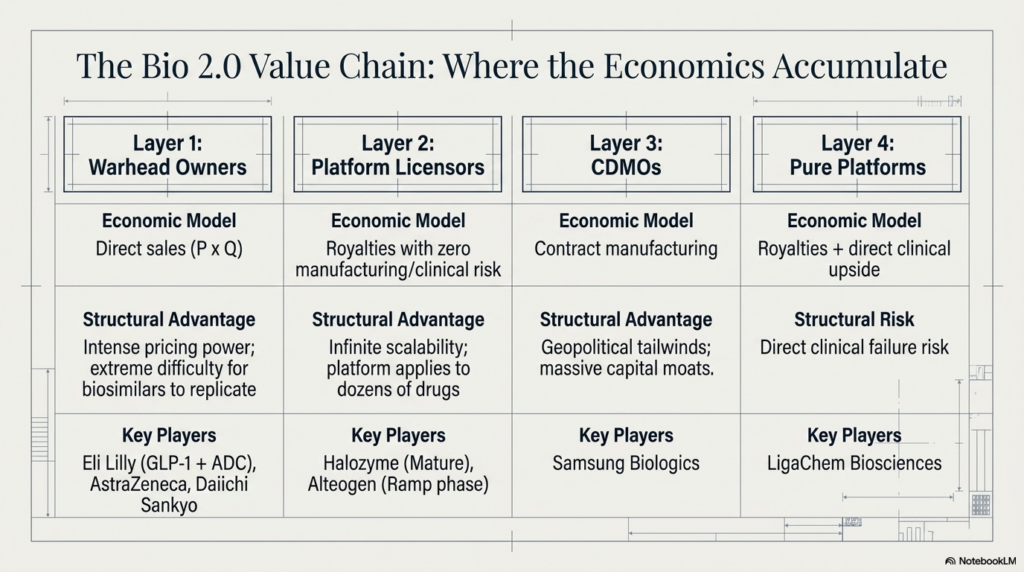
LigaChem Biosciences (141080 KQ) has licensed its ConjuAll linker platform to Amgen, Ono, and other partners. Phase 1b data from its lead ADC candidate is expected in Q3 2026, the first direct clinical validation of a Korean ADC platform in a global trial.
The Hidden Bottlenecks
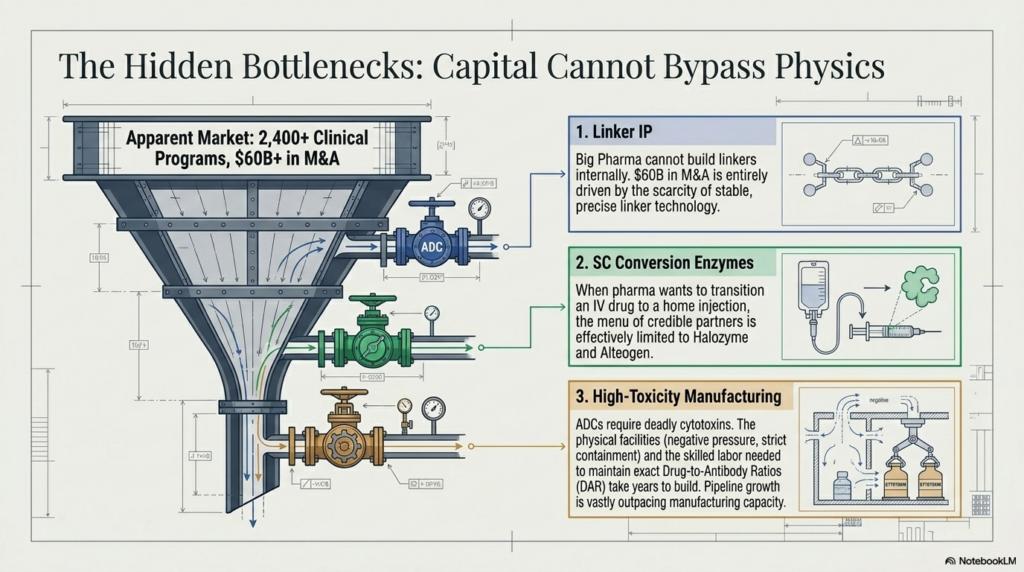
Layers tell you where the economics land. Holding on to them is a separate problem, and that takes a position no one can route around. Three chokepoints run through the layers without appearing clearly in any single company’s story.
The first is linker technology. Lonza’s acquisition of Synaffix, Gilead’s acquisition of Tubulis, Lilly’s acquisition of CrossBridge Bio were all motivated by linker IP. Billions of dollars paid for linker platforms is itself evidence of scarcity value. One qualification belongs here. Buying a linker and owning one are not the same thing. Until the premium paid returns as clinical data, the owner of this bottleneck has not been decided.
The second is the subcutaneous conversion enzyme. Hyaluronidase has no effective substitute. Comparable technology exists in Korea, though the depth and scale of its commercial partnerships have not yet reached parity. When a pharmaceutical partner decides to convert a biologic to subcutaneous delivery, the menu of credible options runs to two or three names. Of the three bottlenecks, this is the one with the clearest owner. What the market is watching, however, is not the partner count. It is the expiry clock.
The third is high-toxicity manufacturing competence. Payloads are lethal if mishandled. Containment facilities, negative-pressure environments, protective systems, and regulatory clearances take years to assemble. This is the kind of bottleneck where money cannot buy time.
People compound it. Maintaining a consistent DAR — the drug-to-antibody ratio — across production batches is what separates a working process from a failed one, and small process deviations change both efficacy and safety. The global pool of operators who can run that process reliably is narrow. A facility without people does not run.
The rate at which Big Pharma expands its ADC pipeline and the rate at which the infrastructure to manufacture it comes online are not the same. The BIOSECURE Act narrowed that passage once more. We have watched what happens in other sectors when a policy timeline lands on top of a supply bottleneck.
Three Filters
Finding a bottleneck does not make it a field. We ran the candidates through three filters stacked on top of each other.
The first filter is the bottleneck. Is there genuinely no way around this position? If even one substitute exists, price erodes over time.
The second filter is valuation. A strong bottleneck and a bottleneck already reflected in the price are different things. A chokepoint everyone knows about is an excellent business but not necessarily an excellent entry point. Conversely, when the market marks something down there is usually a reason, and the work is separating the structural reasons from the temporary ones.
The third filter is the spring wind — our shorthand for whether the season is close enough to matter. A position can clear the first two and still leave you holding a seed in ground that will not turn for years. So the last question was whether there is a date on the calendar: an approval action date, a clinical readout, a milestone recognition point.
In this deep dive we plotted the first two axes on a grid. Most candidates were caught by one of them. Either the bottleneck was real and the price already carried that fact, or the valuation was attractive and the bottleneck belonged to someone else. What is left in the upper-right quadrant can be counted on one hand.
The positions that survived each carry a question.
Can the buyers of linker platforms convert the premium they paid into clinical data? For the owner of the enzyme, is 2027 an ending or the start of the next chapter? For the company that built the facility first, will utilization follow the capacity? And for the position still in its initial ramp, when does validation actually arrive?
The answers are not in the financial statements. They are written on the dates still to come.
Upcoming Triggers
The catalysts are lined up and dated.
In Q3 2026 LigaChem’s lead candidate reports Phase 1b data, the first global clinical validation of a Korean ADC platform. On October 10, 2026 the FDA action date arrives for I-DXd — the fourth DXd-based program and a potential re-rating trigger for the platform. The second half of 2026 brings the European and Asian launch of orforglipron, which begins opening oral GLP-1 to the untreated majority of eligible patients, alongside Enhertu’s final approval decision in early-stage breast cancer and Genmab’s petosemtamab Phase 3 readout. The first widens the treatment line and the patient pool with it. The second determines whether the pipeline can stand in front of the Darzalex cliff.
Beyond that, ENHANZE’s core patent expires in 2027, the point at which the discount is either realized or dissolved. Samsung Biologics’ ADC facility reaches full utilization across 2027 to 2028, when the BIOSECURE tailwind becomes visible in reported numbers. In the 2030s, Hypercon royalties open the second-generation lane in subcutaneous conversion.
Where This Breaks
The clearer a structure looks, the more carefully you should define what breaks it. Three signals are worth monitoring.
The first is CDMO order flow and utilization. Daiichi Sankyo’s FY2025 special loss showed what happens when pipeline expectations and real demand come apart. A bottleneck turns into idle capacity fast.
The second is the first biosimilar formulation approval after 2027. If a viable route around the co-formulation IP opens, the moat logic in the second bottleneck has to be re-examined from the ground up.
The third is ADC clinical failure rates. If more than $60 billion of M&A does not come back as data, the premise of linker scarcity weakens. The readouts over the next twelve months should provide much of that answer.
Closing
That the delivery format of medicine is changing is already established. 2,400 clinical programs. $60 billion in M&A. What the market has not fully priced is not the existence of the revolution. It is which positions inside it actually capture the structural value, and where the meaningful profit is created.
Memory was the defining bottleneck of this cycle. Once that bottleneck is fully recognized, capital looks for the next structural position. This deep dive is our attempt at a small answer to that question.
Healthcare is defensive by nature, which is another way of saying the ground holds in most weather. We regard Bio 2.0 not as a peripheral cell on the Mega Wave map but as one of the core sectors of this era.
A farmer studies the soil before choosing the seed. This article was about the soil. If you came for the structure, this is enough. If you want to know which positions cleared all three filters, and where they sit on the valuation map today, the deep dive is linked in the profile.
[Deep Dive Research] Bio 2.0 — The Delivery Revolution in Medicine by Growth Wave
Read on Substack
Ciao. 🌱