This article is a summary of “The Bigger the Chip, the Fewer the Substrates: Three Layers of Materials, Two Seeds,” published on September 10, 2026. Figures and target prices are available in the original.
Buongiorno.
In my last letter, #34, I noted the fifth scene from Semicon Taiwan. Unimicron’s (3037 TT) chairman said publicly that substrates are in short supply, and Broadcom (AVGO US) named substrates as a bottleneck. Until then, substrate scarcity had been treated as an earnings story for Korean PCB (printed circuit board) makers. Now the people running the global supply chain have acknowledged it themselves.
Korean substrate names rose sharply in the first half and have since given back close to half of it. A field (my word for an investment theme) can come down even when the soil is good, simply because the price was paid first. So this research focused on two questions. In a bottleneck that has already been priced, is there still room to plant a seed (my word for a new position)? And if the bottleneck has moved, where does an opening remain?
I’ll go through it in order: what a substrate is and who makes it where, why it is short, how to read the phrase “the bottleneck is moving,” which companies I looked at, and where ground remains.

1. What a substrate is, and who makes it where
A substrate is the board a chip sits on. It carries electrical signals between the chip and the motherboard. As AI chips grow, the substrate has to get larger, carry more layers and use more demanding materials.
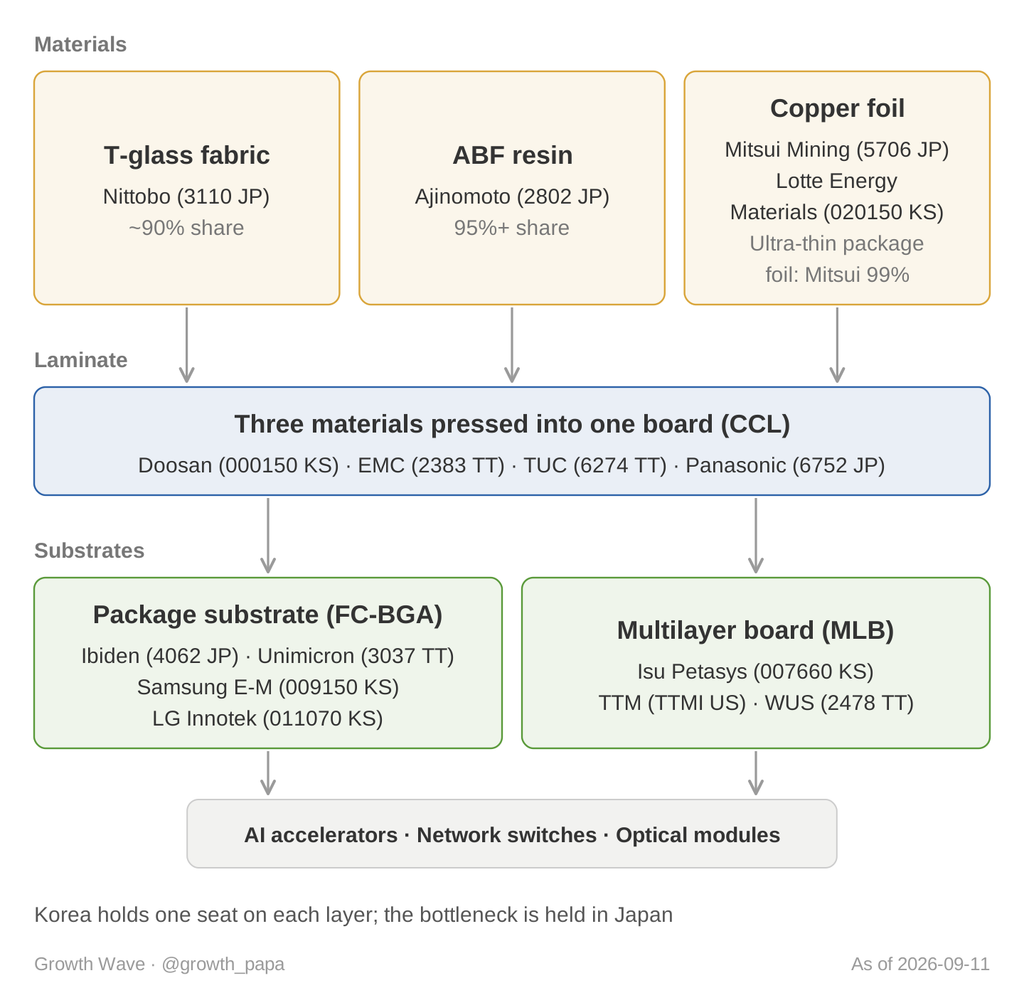
A substrate is built in three stages. The first stage is materials, which come in three plies: glass fabric (the skeleton, which must not expand under heat), resin (the insulating film wrapped around it) and copper foil (the conductor). In the second stage, those three are pressed together into copper-clad laminate (CCL). The last stage is the finished part most people mean by “substrate”: the package substrate that sits directly under the chip (FC-BGA), and the multilayer board that connects chips inside a server (MLB).
Korea holds one seat at each stage: Lotte Energy Materials (020150 KS) in copper foil, Doosan’s (000150 KS) Electro-Materials BG in CCL, Samsung Electro-Mechanics (009150 KS) in FC-BGA, and Isu Petasys (007660 KS) in MLB.
The bottleneck sits elsewhere. T-glass, the most demanding glass fabric, is roughly 90% Nittobo (3110 JP). The resin, ABF, is more than 95% Ajinomoto (2802 JP). Ultra-thin package copper foil is 99% Mitsui Mining & Smelting (5706 JP). Among finished substrates, the leaders are Taiwan’s Unimicron and Japan’s Ibiden (4062 JP).
Each of Korea’s four holds a seat along the chain, but the bottleneck is held in Japan. That distinction runs through the rest of this piece.
[Figure 1: The three stages of the substrate value chain and who sits on each]
2. Why it is short: supply is blocked, demand has split and grown
The supply constraint
The core narrative of this cycle has become area multiplied by layer count. The substrate area a single chip demands has grown. New-generation GPU substrates are more than 70% larger than the prior generation, and some ASIC (custom chip) substrates are more than double. On Meritz Securities’ arithmetic, a single 515×515mm panel yields 270 substrates at 830㎟ each, but only 20 at 10,000㎟. The number of chips the same equipment can serve falls accordingly.
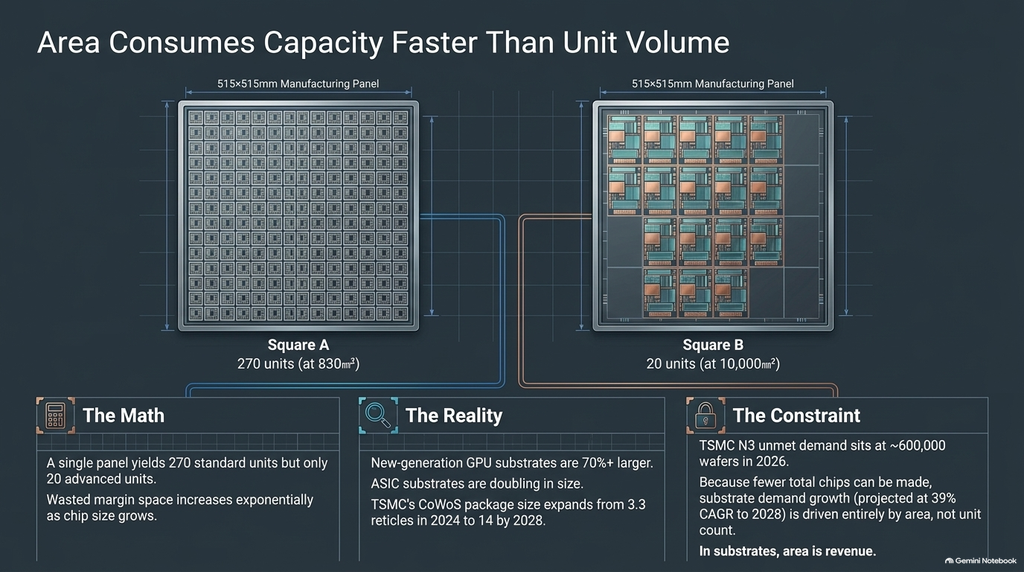
Price follows area too. Samsung Electro-Mechanics confirmed on its late-August call that pricing is set by area. Area is revenue. A Taiwanese advisory firm estimates ABF substrate area demand growing 39% a year from 2025 through 2028, tipping into shortage in 2027 and opening a gap of nearly 30% by 2028. TSMC’s (2330 TT) roadmap has CoWoS (TSMC’s advanced packaging) growing from 3.3 times the reticle (the area one lithography exposure covers) in 2024 to 14 times by 2028.
The chip side is blocked as well. According to J.P. Morgan’s Semicon Taiwan tour notes, unmet demand for TSMC’s N3 (3-nanometer) process is roughly 600,000 wafers in 2026, and larger in 2027. With chip output capped, substrate demand growth comes from area. That is why area became the spine of this piece.
The demand explosion
Look only at finished substrates and demand converges on data center servers. Step one stage upstream and the picture changes. The same CCL goes into server motherboards, 800G switches and optical transceivers (parts that convert between light and electrical signals). That is why Doosan Electro-Materials’ revenue mix is 60% network, 14% package and 5% optical module. Mitsui’s ultra-thin foil also comes off one line and splits between semiconductor packages and optical transceivers. Materials take several strands of demand on a single line.
June and July exposed the difference. Per J.P. Morgan, shipments of Nvidia’s (NVDA US) NVL72, a server rack of 72 GPUs, stalled at about 8,000 a month. Over the same stretch, Mitsui’s optical-transceiver foil went from 200,000–250,000㎡ a month to 600,000㎡. One strand stopped and another filled the line. So when I look at substrate materials, I watch the pace of the move from 800G to 1.6T rather than GPU shipments. That pace shows up clearly at Coherent (COHR US), which we already track.
Supply is constrained by both area and unit count, while demand keeps adding strands that converge on one line. That is why the shortage bites hardest, and lasts longest, at the material stage.
3. The four places the bottleneck has moved
Letter #34 argued that the bottleneck is changing seats. I traced how that plays out inside substrates using four companies’ August calls and half-year filings.
The first seat was the factory: a shortage that eases when substrate makers add capacity. That phase already played out once in 2025. Taiwan’s three leaders, Isu Petasys and Daeduck Electronics (353200 KS) have all begun expanding, and factory capacity itself is rising.
The second seat is materials. Ajinomoto is running its lines flat out, has told customers it will prioritise AI and high-spec products until new capacity arrives, and raised prices by roughly 30% from the third quarter. Demand for Nittobo’s T-glass has exceeded capacity since the second half of 2024, and Apple (AAPL US) has stationed staff at material suppliers to secure volume. Doosan’s half-year filing shows glass fabric purchase prices up 34% versus 2025 and copper foil up 35%. Material suppliers are setting the price.
The third seat is capacity allocation rights. Substrate leaders that have secured materials now sell their capacity forward. Samsung Electro-Mechanics says customers are requesting capacity allocations from 2028 out to 2032–33 and paying capex subsidies in return. Daeduck Electronics says most of its 800 billion won investment will be funded by advance payments under customers’ long-term supply agreements. Customers are buying capacity.
The fourth seat is equipment. According to Daeduck, lead times for laser drills used on large-body substrates have stretched from six months to ten to twelve, so an order placed now arrives in 2028, and the company is focused on securing used tools. J.P. Morgan reports that backlog visibility at Taiwan’s Eternal Precision Mechanics (7795 TT), the leader in vacuum lamination equipment (which presses insulating film onto substrates), now extends to 2030. Consumables are short as well. Drill bit consumption rises with layer count, and Taiwan’s Topoint Technology (8021 TT) plans to take monthly capacity from 35 million bits to 90 million by the end of 2028.
One more observation. The further up the chain the bottleneck moves, the longer the shortage lasts. Expansion plans are plentiful, but equipment cannot keep pace, and the capacity that does get built is already tied up in long-term contracts. Those two facts make the market’s fear of oversupply from simultaneous 2028 expansions look unlikely. In my view, equipment lead times set how long the shortage runs.
4. Which companies I looked at
Four Korean names, three Japanese and three controls. One screening rule: the label is old, but the money is going to the new business.
Lotte Energy Materials is classified by the market as a battery copper foil company. Yet next year it will convert most of its Iksan battery foil lines to circuit foil (copper foil for substrates), taking capacity to 16,000 tonnes, and it says it will decide on another 10,000 tonnes within this year. A business stuck at about 6,000 tonnes a year from the early 2000s through 2025 quadruples in four years. On its call, the company shelved LFP cathode expansion and said plainly that it will concentrate on semiconductor substrates, where Chinese competition is thinner and end customers can afford to pay.
Samsung Electro-Mechanics is known as an MLCC (multilayer ceramic capacitor) company. Yet more than 60% of this year’s 4–5 trillion won capex goes to FC-BGA, and over three years it plans 9–10 trillion won for substrates against 3–4 trillion won for MLCC. The company is rewriting itself as a substrate maker with its money.
Doosan is a holding company. Yet its half-year filing shows Electro-Materials BG at 12% of consolidated revenue and 4% of assets while producing 43% of combined segment operating profit, at a 30% operating margin in the first half. Input costs rose 34% while selling prices rose 15%, and the margin still widened from 26% to 30%.
Isu Petasys is the only one of the four whose label matches its business. The market found it first, and it is the most closely analysed.
The three Japanese names hold the bottleneck. Nittobo was a textile spinner; electronic materials now make up 89% of its operating profit. Mitsui Mining & Smelting is a smelter known as “Mitsui of zinc,” yet its functional materials segment produces 78% of recurring profit. Mitsubishi Gas Chemical (4182 JP) makes methanol and hydrogen peroxide, and is also the world leader in BT (a heat-resistant resin for memory package substrates).
5. Where the profit stays
With these companies laid out, I focused on where the profit stays. The same cost wave hits every stage, but profit structure and moat split clearly by position in the supply chain. Materials set the price, CCL holds up through product mix, and PCB makers pass the increase on in their own prices.
On that structure, I chose two spots. Which ones they are, and the coordinates for each (my read of where the price sits against scenario values), are in the full piece.
6. The uncomfortable truths
The first risk is Nvidia’s next-generation Feynman. It is reported to move to 3D stacking, GPU on GPU, in 2028, and that could break the area narrative. That is the year the spine of this piece goes on trial.
The second is glass. When Taiwan Glass (1802 TT) completes its third expansion phase in 2027, commodity glass fabric prices could come under pressure. The question is whether high-end T-glass pricing follows them down. The third is Doosan’s balance sheet. Its net debt rises by more than 3 trillion won once the SK Siltron acquisition closes, and market expectations for the third quarter are set above my own estimate.
The fourth is substitution. For Rubin Ultra (Nvidia’s next-generation platform) in the second half of 2027, the backplane is reported to use PTFE, a fluoropolymer, in place of CCL. That could leave CCL unable to capture a seat that newly appears in the next generation. Doosan has fluoropolymer materials on its R&D agenda.
7. What to check, and when
Results across this chain arrive between late October and mid-November: Samsung Electro-Mechanics and Murata (6981 JP) in late October, Nittobo and Mitsubishi Gas Chemical in early November, then Doosan, Isu Petasys, Lotte Energy Materials and Mitsui Mining & Smelting in mid-November.
There is one thing to watch at each position. The first is materials, where the electronic materials operating margin will show whether high-end glass fabric pricing is holding. If it holds, the view that the material shortage runs long is confirmed once; if it slips, expectations on the material side are likely to come down first. The second is CCL: whether the fourth-quarter capacity start is stated. The third is copper foil: whether volume from the fifth Malaysian plant shows up in the numbers. The fourth is substrates: whether price increases stay as profit or end as cost pass-through. Samsung Electro-Mechanics and Murata are priced off the same peer multiple, so the two need to be read together.
Closing
Following the substrate bottleneck led me all the way to the Japanese material suppliers. As usual, nothing easy came from the names that were easy to see. The further into the back half of a cycle we go, the more carefully earnings-based valuation deserves to be examined before planting. I hope we let themes pass without letting them move us, keep faith with what is already planted, and wait for it to sprout. Holding enough cash while planting only where you will not lose is, I think, enough for a season like this one.
The structure beneath the chip is all laid out here. If you want the names of the two spots and their coordinates, you’ll find them in the full deep dive.
🌱 Growth Wave · Full Deep Dive
The Bigger the Chip, the Fewer the Substrates: Three Layers of Materials, Two Seeds
This is a summary. The two names I chose, their full valuation work and the complete earnings checklist are for paid subscribers.Read the full research →
Ciao. 🌱
This newsletter is for informational purposes only and does not constitute investment advice or a recommendation to buy or sell any security. The author may hold positions in the securities discussed. Do your own research and consider your own circumstances before investing.