This article is a condensed version of “The €100,000 Arm and the $20,000 Body: Why I Still Haven’t Planted Humanoids,” originally published for subscribers on July 21, 2026. Valuation figures and price targets are available in the original.
Opening.
Humanoids. Physical AI. I am finally doing the deep dive — along with the reason I avoided it for so long, despite many requests.
Let me start with a confession. I hold this sector to an unusually high bar. Before becoming an investor, I spent well over a decade at a large automation company, starting as a control-systems engineer and moving on to market analysis and overseas business development. Many of the robot and component makers in this article are companies I visited as clients or walked through in person. Knowing the factory floor made my eye harsh. I could not find companies earning meaningful money inside this theme, so I kept humanoids outside my field. In this letter’s farming vocabulary, the field is where I plant positions, and the basket is a visible pool of future profits. No basket, no seeds. That has been the rule.
Then, at this moment, two things converged. The first is valuation. The broad market corrected in July, and robot stocks fell with it. The second is volume. Production of the third-generation Optimus is slated to begin at Fremont as early as late July, and the component supply chain has already started moving. We are at the threshold where prototype time ends and mass-production time opens.

So the question: has the basket actually started to grow while my eye stayed stuck in the past — or is the basket still empty, with only a price tag attached? I will carry that single question to the end of the value chain.
1. The €100,000 Arm and the $20,000 Body
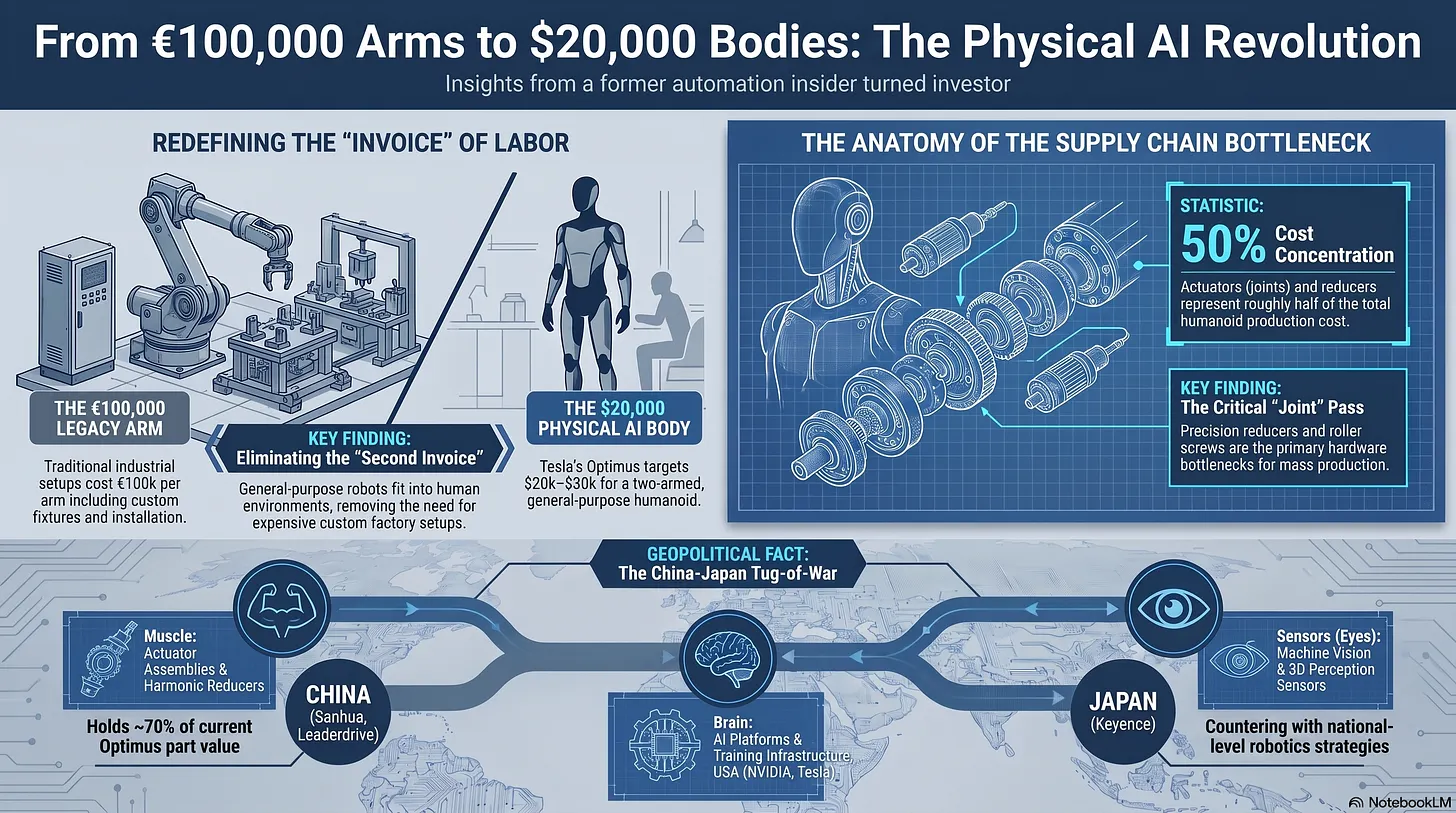
The last project I ran in my corporate life was a collaborative-robot market study across European factories. What surprised me was not the robots but the buyers. They were not large corporations. Small workshops with a few dozen employees were bringing in cobots. My job was to read their invoices, so let me report exactly what I saw. A Universal Robots unit ran €20,000–30,000. Once a dealer built the jig (a custom fixture that holds the workpiece in place), wrapped the cell in safety equipment, and finished setup, the final bill for one automation assembly landed around €100,000.
For €100,000, what they bought was a single arm — bolted in place, repeating taught motions on one designated part. And still the orders were backed up, because against one worker’s wages the math paid back within a few years. I was also once invited into Fanuc’s (6954 JP) headquarters at the foot of Mount Fuji, a place that rarely opens even to the press, and saw robots building robots: a kingdom of precision machinery decades in the making.
The conclusion I filed after that European tour was simple. Factories that want robots already exist in abundance; the problem is not the robot but making the robot work. The real barrier to robot adoption was never the machine’s price. It was the second bill — setup — which cost more than the machine itself. That was as far as my thinking went. What I never imagined was that the second bill could disappear entirely.
The person who first forced that thought was Musk, when he named $20,000 as the mass-production target for Optimus. I initially filtered it as standard Musk hyperbole. But the number did not move with time. At the 2025 shareholder meeting, Tesla ($TSLA) management confirmed $20,000 at scale as the official target, and this January in Davos, Musk restated the marker: general sales by late 2027, at $20,000–30,000. To someone who has read those European invoices, this number sounds different. In a world that paid €100,000 for a one-armed assembly, a machine with two arms, two legs, and fingers is arriving at a quarter of that price. And because a general-purpose machine needs no fixed installation and no jigs, the second bill thins out as well.
If this price is realized, I read it not as an expansion of the robot market but as a redefinition of it. Industrial robots ship in the hundreds of thousands per year because that is how many buyers could afford to rebuild their factories around the robot. A $20,000 general-purpose machine works the other way: it fits itself into the human environment. The small workshops that hesitated over jig costs, the sites that gave up on automation because the task changed daily, and beyond the factory fence, warehouses and service businesses — all of them join the buyer list. Just as Ford’s conveyor belt broke the price of the automobile and created transportation for the masses, breaking the price of the robot opens a new industrial revolution: the mass production of labor. Jensen Huang repeatedly naming Physical AI as the next wave of AI reads to me as the same picture seen from another seat.

Of course, all of this is still the size of a promise. Weight and safety — conditions no one from the factory floor takes lightly — will get their own treatment later. Before that, there is one thing to confirm first: the first ship of this wave is already in port.
2. The First Ship Is Already in Port
If Physical AI still sounds unfamiliar, start with this definition: AI that used to make text and images inside a screen stepping outside it to perform labor in the physical world. If the chatbot is the head, Physical AI is the work of attaching a body to it. Until now we have verified the AI wave mostly in the data center — in power, in memory, in optics. But for AI to truly earn the title of industrial revolution, there is one final gate it must pass: labor in the physical world. Revolutions complete themselves when they change the cost of work once done by human hands and feet.
The body is arriving in two forms — wheeled and legged. The wheeled one has already arrived.
Last June, Tesla launched its robotaxi service in Austin. It began as supervised, limited operation, moved through the Bay Area, and this summer reached unsupervised driving in Miami. Cumulative paid miles approached 700,000 as of the last earnings call, and the company announced expansion plans for seven more cities. The debate over safety and maturity is ongoing and deserves respect. But translated into an investor’s language, it reads like this: receipts for Physical AI selling labor are already being issued. The amount is not the point. The point is the proposition it proves — that a business where AI works in the physical world in place of a person, and gets paid for it, holds up technically, legally, and commercially. Through last year that proposition was a forecast. Now it is a fact.
So the question moves on: when, and where, does humanoid revenue and profit begin?

Between wheels and legs runs a river. Robotaxis are built on the existing automotive supply chain — body, battery, motor, all parts of an industry that already stamps out tens of millions of units a year. The bottleneck was software and regulation, not hardware, which is why the moment that gate opened, the cars started running. A legged body is different. A machine with dozens of joints demands components no industry has ever produced in the millions per year. The brain is getting ready, but the supply chain to build the body does not yet exist. The river dividing robotaxis and humanoids is named not intelligence but supply chain. So from the next chapter, we look not at the robot but at the bill — which line the money is leaking from. That is the address of the bottleneck this article is looking for.
3. Dissecting the Bill
By McKinsey’s analysis, a humanoid prototype costs between $30,000 and $150,000 to build. The spread itself is evidence that this industry is pre-mass-production: components are being sourced in small lots, sometimes custom-made. Between the $20,000 target and today’s body price lies a gap of two to seven times. Let us read the bill from the top to see where that gap is stacked.
The first line, and the largest amount, is actuators — the joints. Each is a module bundling motor, reducer, sensors, and control circuitry; a single humanoid carries dozens of them, and together they account for roughly half of total cost. The problem is that the direction is running backwards. The third-generation Optimus is estimated to carry about 50 actuators in its hands and arms alone — more than four times the density of the prior generation. The better the dexterity, the more joints; the more joints, the further the cost target recedes. The $20,000 promise is effectively a declaration that this tension will be resolved by collapsing component prices.
The second line is the brain and the senses: AI compute, cameras, sensors. Large in amount, but I do not worry about this line. Smartphones, EVs, and data centers have already paved mass production in the billions of units, so the path down is visible once volume arrives.
The third line is the tricky one: rare-earth permanent magnets. The neodymium magnets inside every joint motor are small in cost share, but this line differs in kind — it is not a question of how much but of who sells. China controls 90% of refining and processing, and export licenses have already been used as a diplomatic card. Mass production solves the other lines’ costs; on this line, the larger the volume, the heavier the geopolitics.
And at the bottom of the bill sit two unprinted lines. The first is weight. Today’s humanoids are mostly 50–90kg blocks of metal, and the question of what happens when a machine of that mass falls or collides with a person remains open. Safety was exactly why European factories paid as much for cobot setup as for the machine itself. The promise of “working beside people without jigs or fences” is a promise made before climbing the mountain of safety certification. The second is the battery. Published runtimes are mostly 2–5 hours, while a three-shift factory day is 24. Swap charging can solve it, but at that moment the “replaces one worker” calculation gains new lines: spare units and charging infrastructure.

To summarize: the brain and senses have a visible path down. Weight and batteries need time but are engineering problems. The joints, however — above all reducers and precision parts — have no mass-production system anywhere in the world, and the magnets sit under geopolitics regardless of volume. In the next chapter, we name, one by one, who actually holds this narrow pass.
4. The Center of Gravity Is China, the Counterattack Is Japan
The heart of the joint module is the reducer — a precision gear device that trades a motor’s fast rotation for force, cutting revolutions by factors of tens. A humanoid’s reducer must do that job inside the size of a wristwatch, at hundredth-of-a-millimeter precision, for tens of thousands of hours. It is a world of sculpting gear teeth, not cutting them. That is why 30–50% of actuator cost sits in this one part, and why lead times run 26 weeks. There are three main types: harmonic reducers for precision joints like wrists, RV reducers for load-bearing joints like legs, and planetary roller screws for linear-force joints. Roller screws in particular can be made by only a handful of companies worldwide, which is why cost analysts flag them as the most urgent bottleneck.
This world of precision machinery was long a Japanese kingdom. Harmonic Drive Systems (6324 JP) created the harmonic reducer category itself, and Nabtesco (6268 JP) has effectively split the industrial-robot RV market. When I was in the field, it was common knowledge that whatever a robot maker’s nationality, opening the joint revealed Japanese parts.
Open the Optimus bill today, and different names appear. Aggregating component-tracking analyses, roughly 70% of third-generation Optimus component value hangs on the Chinese supply chain. Sanhua (002050 CH) was appointed sole supplier of actuator assemblies, receiving a $685 million order last October; Tuopu (601689 CH) took the rotary actuators. And the harmonic reducer: Suzhou-based Leaderdrive (688017 CH) undercut Japan by 40% on cost, took over 35% of the global market, and became sole supplier to Tesla’s Mexico line. With 30% of revenue already coming from humanoids, it is nearly the only component maker on earth doing humanoids as earnings rather than as a theme.
The kingdom’s walls fell quietly. It was not the technology that collapsed — it was price that brought the walls down. Japanese parts still sit above on quality and lifespan, but “an industrial robot that lasts 20 years beside a person” and “a general-purpose robot that must hit $20,000” demand different grades of quality. In the latter world, the side selling good-enough parts at half price wins. The throne of technology stands untouched while the definition of the market that needs it changes — that, in my reading, is the original’s real problem.
Japan is not blind to this board. In March this year, Japan’s Cabinet Secretariat officially announced an “AI Robotics Strategy”: over 30% global share and a ¥20 trillion market by 2040, with the state subsidizing mass-production capex for critical components, open-sourcing a robot foundation AI model by June 2027, and manufacturing demand through adoption targets across 18 sectors. On the private side, a consortium of 13 companies — Murata (6981 JP), Renesas (6723 JP), Sumitomo Heavy Industries (6302 JP), Mabuchi Motor (6592 JP) and others, with Waseda University leading design — plans a humanoid prototype by year-end. The capex-support clause for component mass production reads as a signal that the government knows the bottleneck’s exact address.
Here I want to set up this article’s key lens. Bottleneck ownership and de-China substitution are different theses. The side actually holding the bottleneck and earning money today is China. The Japanese and American component thesis is “demand that returns someday, when American OEMs want a supply chain outside China.” The first is current revenue; the second is a conditional option. The same distinction holds in magnets: China sells the magnets today, while MP Materials ($MP) — which the US government is nurturing with price-floor guarantees — is the flagship of the conditional option.

On this map, I read the distribution of income as follows. If the board hardens, the income from service operations and brain platforms goes to America; the income from mass production and cost goes to China; and Japan contests the income from core precision components with China. To be blunt, Korea’s seat at this table is not distinct. The one meaningful exception I see is Boston Dynamics under Hyundai Motor (005380 KS). The grounds for that judgment come in the next chapter’s map.
5. From Brain to Fingertips: The Map and the List
Mapping one humanoid onto the human body, the value chain splits into five axes: brain, eyes, nervous system, muscles, hands.
Brain. The intelligence that trains and drives the robot. The field has already narrowed to Tesla, vertically integrated with its own chips and its own AI, and Nvidia ($NVDA), which sells everything from training infrastructure to robot foundation models to nearly every other robot company. Whichever OEM wins, training passes through Nvidia — so the brain axis has essentially one pickaxe seat, the gold-rush toolmaker who profits no matter which miner strikes gold. One note: the inference chip inside the body must run within the power a battery allows, a low-power fight that leaves the door open to mobile players like Qualcomm ($QCOM). On the finished-robot side stand Tesla, UBTECH (9880 HK), Unitree ahead of its listing, Japan’s big three (Fanuc, Yaskawa, Kawasaki Heavy Industries), and Hyundai’s Boston Dynamics.
Eyes. Cameras and machine vision. Smartphones and autonomous driving have already paved sensor mass production, so this is no bottleneck. But “not a bottleneck” and “not making money” are different things. A company like Keyence (6861 JP), holding the inspection-and-measurement eyes that sell with every added robot, sits where revenue grows on the wave’s mere existence, not its size.
Nervous system. The control semiconductors on every joint. No pure beneficiary stands on this axis, for two reasons. The first: robot MCUs and drivers are near-commodity parts split among STMicroelectronics, Infineon, Renesas, and Texas Instruments — no monopoly, no pricing power. The second: the semiconductor content per robot is too small against these companies’ total revenue to move the needle for years. I will revisit this axis when per-unit content becomes meaningful.
Muscles. Actuators, reducers, motors, magnets — the bottleneck’s home ground, its names all called in the previous chapter. Current revenue: China (Sanhua, Tuopu, Leaderdrive). Conditional options: Japan (Harmonic Drive Systems, Nabtesco, Mabuchi) and America’s magnets (MP Materials). Names like THK (6481 JP) and Nidec (6594 JP) also appear on the map, but the longer the robot theme has visited a name, the more often expectations arrived at the price first.
Hands. The last axis to open. It is a density fight of micro-actuators and tactile sensors; names like Robotis (108490 KS) and Zhaowei exist, but the market itself has not yet formed.

Before folding the map, let me fill in Korea’s box honestly. Domestic reducer and actuator makers have reached localization rates in the 40% range — meaningful progress, but localization measures “can build,” not “is selling.” Humanoid revenue is still effectively unobservable in their financial statements. The captive-demand case at Rainbow Robotics (277810 KS), whose largest shareholder is Samsung Electronics (005930 KS), and at Doosan Robotics (454910 KS) remains a possibility not yet converted into purchase orders, and the ₩1 trillion of Korea’s K-Humanoid Alliance is a budget figure, not any company’s backlog. The one exception, Boston Dynamics, targets Atlas mass production in 2028 — outside the four-to-eight-quarter window this article watches. The two conversion signals I will track: the moment captive possibility becomes actual orders, and the moment the Alliance budget’s company-level allocation is fixed. Until then, Korea’s box stays on the map but out of the basket.
On this map, the list I will run valuations on is thirteen names. The criteria are simple: does profit exist today, and does that profit stand in the wave’s path? Five from America: Tesla, owner of both robots (robotaxi and Optimus); Nvidia, the brain’s pickaxe; Uber ($UBER), the gateway of demand; Teradyne ($TER), the cobot original with a test-equipment core business; and MP Materials, the de-China magnet channel. Five from Japan: Fanuc, both OEM and toolmaker; the two reducer originals, Harmonic Drive Systems and Nabtesco; Mabuchi on motors; Keyence on eyes. Three from Greater China: Sanhua, Tuopu, and Leaderdrive, the holders of today’s actual revenue. These three pass the profit-exists test but have their earnings power under examination, so I treat them as a separate class of verification targets — and Unitree I will observe without a valuation, using the price the market assigns in its listing as the benchmark itself.
The list is on the table. Now this article owes you its honesty.
6. Inconvenient Truths
What the map does not say. Four things.
The first: the sector’s next one to two years hang, in effect, on one company’s production schedule. Walk through the near-term revenue scenarios of the names above and most turn out to be derivatives of a single variable — the scale-up of Optimus. And the owner of that variable has a long record on schedule promises. Optimus timelines have slipped repeatedly, and the robotaxi’s history has been a series of arrivals later than announced. The direction has been right; the clock has always run optimistic.
The second: the closer a company stands to the wave’s front line, the sooner its earnings power goes on trial. This runs against intuition. Price competition in humanoids and components has already begun inside China, and Unitree, at its center, saw profit halve while shipments grew. Several OEMs carry 10,000-unit production targets; if demand does not keep that pace, what remains is inventory and discounts — the grammar of Chinese-style growth we have already watched in autos and solar. Pure exposure earns the most when the wave comes, and bleeds first when the wave runs late.
The third: US–China tension cuts both ways for every player on this map. For Chinese component makers, geopolitics is a cost, not a tailwind — moving lines to Mexico and Thailand to dodge tariffs (nearshoring) shaves margin by itself. Conversely, the de-China options held by Japanese and American makers lose value if tensions ease. Whichever way the politics move, someone’s thesis weakens, which makes geopolitics a dangerous base for a one-way bet.
The fourth: even if the wave is real, the basket may fill later than expected. Some cold arithmetic: all of China shipped in the mid-10,000s of humanoids last year, and even Optimus hitting this year’s target means tens of thousands of units. Priced generously per unit, that volume struggles to exceed single-digit percentages of the large component makers’ annual revenue. TAM is the size of the destination, not next year’s sales. Ignore that lag and pay the narrative’s full size, and you are standing exactly where I have avoided standing: price tag, no basket.

The reason I keep writing while holding these four is to know precisely what confirmation would make the basket real, and when that confirmation arrives.
7. A Summer Crowded with Inflection Points
The inspection calendar.
This season (late July–autumn). The nearest inflection point is the third-generation Optimus. Fremont production is slated to begin as early as late July or August. What to check is not the pageantry but three things: whether the line actually runs, the initial production rate, and any company commentary on whether the cost target survives the surge in hand-and-arm actuators. Unitree’s STAR Market listing also belongs to this season: as the mainland’s first humanoid IPO, the price the market pays for “the number-one OEM whose profit just halved” becomes a public benchmark. On robotaxis, the speedometer of the first ship is the actual opening of the seven announced cities, additions to unsupervised zones, and the start of Cybercab production targeted within the year. In Japan, watch the publication of adoption targets across the 18 sectors and the Waseda consortium’s prototype reveal; in Korea, the company-level allocation of the K-Humanoid Alliance’s ₩1 trillion budget.
Next year and beyond (2027–2028). June 2027 brings the open-source release of Japan’s AIRoA robot foundation model — the first test of the strategy of giving the brain away to win in components and finished robots. Late 2027 is the Optimus general-sales date Musk fixed in Davos; whether a $20,000–30,000 price tag actually appears before consumers becomes the grading sheet for this article’s entire first chapter. And 2028, the Atlas mass-production target, is the earliest date Korea’s box could turn into a basket.
Undated, but watched. The only exit from single-variable risk is the appearance of a second large buyer — production contracts at American OEMs like Figure or Agility, or a mass-deployment announcement from a logistics giant of the Amazon class. In the opposite direction, the deepening of China’s price war and the return of rare-earth export controls stay under surveillance.
8. Valuation: Thirteen Coordinates
The purpose of this valuation is not to time the stock but to check which scenario today’s price already contains. Coordinates, in this letter’s vocabulary, means where a price stands against estimated value.
The method first. I sorted the thirteen names by supply-chain position and business character into four types — mature growth, cyclical, transition growth, and early-stage or turnaround — and for each type derived a fair midpoint from a conservative scenario and an overheat ceiling from an aggressive but logically defensible one. The midpoint between those two values serves as the baseline, and I measured each stock’s distance from it, deducting dilution risk in advance for names with fragile balance sheets.
The numbers themselves belong to the original; here I will carry over only the one structure the sorted table revealed. Platforms and gateways clustered at the top; the reducers — the bottleneck’s home ground — clustered at the bottom. The closer a name sits to the bottleneck, the more the market has already paid.
The thirteen coordinates split into three zones. Below the baseline gather names standing in the wave’s path while wearing the clothes of another core business — profits real and growing, but prices pinned beneath earnings by the market’s worries. Around the baseline stand names where the correction removed the froth but left no discount, names the market is pricing roughly right. And above the baseline sit the names that shine brightest in this article’s narrative — names whose ceiling, even with every optimistic scenario realized, sat at or below the current price. The clearer the story, the more fully the market has already paid.
So what remains before each name is not a conclusion but a question. For Tesla: does the $20,000 cost target survive a fourfold jump in hand-and-arm actuators? For Nvidia: does big-tech capex truly decelerate next year, or is the worry running ahead of the results? For Uber: is autonomous driving the threat that erases its seat, or the gateway where demand gathers? For Teradyne: does the cobot business, attached to the company with no price on it, get repriced? For Harmonic Drive Systems: once the market’s definition changes, can the throne’s technology still command its price? For Leaderdrive: does 30%-of-revenue purity convert into earnings power? For Tuopu: does the robot revenue that just entered its financial statements turn into a jump?
Which name stands in which zone, and what coordinate I attached to each question, is covered in the original.
9. What the Matrix Says
If valuation is the coordinate of price, the matrix is the coordinate of time. One axis is distance from the baseline; the other is the dated trigger — the presence and directional certainty of a scheduled event that can move the coordinate.
When I drew this board, the upper right — where undervaluation and an imminent trigger overlap — held a single name, standing alone. But the upper right is a place to doubt in proportion to its appeal. The market has its reason for that price, and the truth of that reason will be measured in the announcements scheduled between late July and late August. Depending on what they show, the coordinate may have to be redrawn that very day. It is an upper right with a clear checkpoint before entry.
Just left of the boundary stand names that combine undervaluation with dated triggers but fall half a step short on directional certainty, their gates lined up from late August through year-end. In the upper left gather the names that shone brightest in the narrative — names that will move hard when the spring wind comes (my term for the arrival of a favorable phase), but where the market has already collected the full price of admission, leaving little room for the price to answer the wind.
Worth recording, too, is that the lower right is empty. The cheap-and-imminent-but-small-impact seat — the simple gap-closing trade — does not exist in this theme. I read that as Physical AI not yet being that mature a stage.
Closing
Reading cobot invoices in small European factories, I was convinced these machines would change the world — and still could not move that conviction into my account, because I could not see which component maker would earn how much. More than a decade later I stood before the same question, and this time walked the value chain to its end and came back with thirteen coordinates.
A farmer’s job is not to prophesy the wave but to know the state of the field. Rain does seem to be coming. But the furrows rumored to get rain have already risen in price, while quiet furrows that will catch the same rain remain at fair value. Rather than envying the famous furrows, I will write watering dates into the quiet ones’ calendar. From late July through late August, this field’s truths will be revealed in sequence.
If it is the structure you wanted, this article is enough. If it is the numbers you want, the deep research linked in my profile is where they live.
This piece is the condensed version. The full deep dive, including the thirteen coordinates and the matrix, is on Substack.
Read the full research →This newsletter is for informational purposes only and does not constitute investment advice or a recommendation to buy or sell any security. The author may hold positions in the securities discussed. Do your own research and consider your own circumstances before investing.
Ciao. 🌱