
It has been five months since I outlined the structural growth drivers that would lead the market over the next half-year.
https://blog.naver.com/growth_papa/223991700720
I find myself wondering: Is your portfolio currently filled with companies solving the most critical technical and policy bottlenecks? At this moment, capital is viewing Big Tech’s aggressive investments with a skeptical eye. Nevertheless, I believe that technology companies capable of capturing the real benefits of those investments will continue to grow, regardless of short-term market volatility.
Now is the time to have the courage to ride the ‘core problems’ that are already in plain sight, rather than forcing ourselves to read between hidden lines. Leaving behind 2025—a year dominated by inflation and macro factors—2026 will be the year to focus on thecore Tech Bottlenecks 2026, and the subsequent shifts in capital and monetary value.
Here are the three pillars that will define 2026, the specific bottlenecks, and the concrete technologies that will break through them.
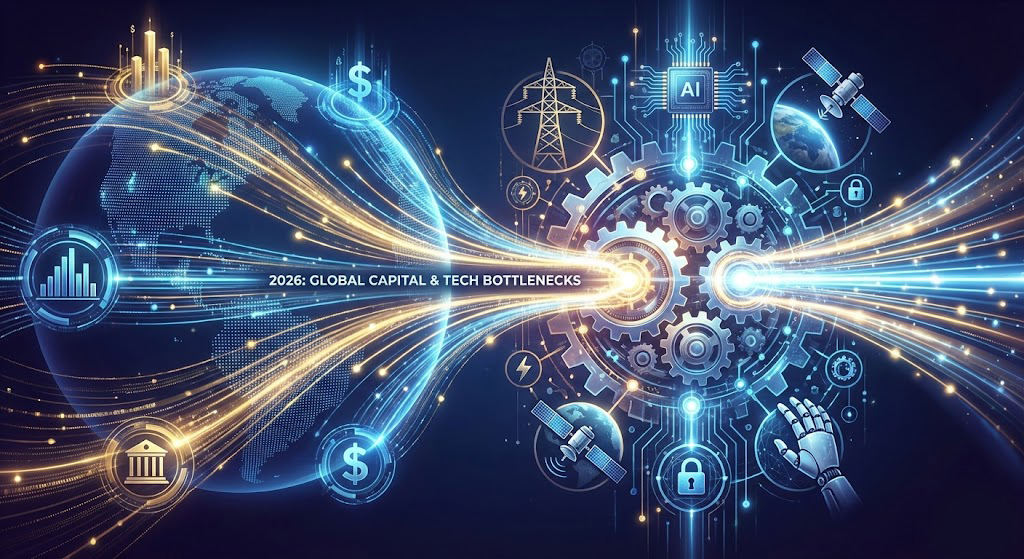
(Note: The core global and Korean companies solving each bottleneck are exclusively covered in my premium strategy report, [Growth Wave]. For those seeking actionable investment targets, please refer to the premium link at the bottom.)
I. Foundation: The Base of Civilization
Without these, neither AI nor factories can operate. Energy and resources are the absolute priorities.
1. Power Grid & Off-Grid Power: Creating Baseload Electricity for AI Factories
- The Conflict: Electricity demand is exploding as AI data centers, EV gigafactories, and reshored manufacturing facilities are built simultaneously. The U.S., in particular, is facing a bottleneck so critical it has become a matter of national security. Renewables alone cannot handle this baseload, and the existing power grid is aging. If this continues, we will face a scenario where we can’t build factories due to a lack of power and grid connections, even if we want to buy more GPUs.
- The Solution: Long-term, High-Voltage Direct Current (HVDC) transmission and Small Modular Reactors (SMRs) must secure the baseload. Short-term, attaching large-scale Energy Storage Systems (ESS) to massive solar farms for 24/7 power supply will rapidly expand. These three axes—Grid Replacement, Nuclear (Baseload), and Solar/ESS (Speed)—must mesh together for AI factories to operate stably.
- Core Tech: HVDC, ultra-high voltage transformers, protective relays, smart grid software; SMR design and main equipment, high-efficiency SOFC systems; LFP-based BESS, PCS, and EMS.
2. Thermal & Water Management: The Hidden Bloodstream of AI and Semiconductors
- The Conflict: The latest AI chips generate tremendous heat. Additionally, ultra-fine semiconductor fabrication requires vast amounts of water, making industrial water security a war-level issue amidst climate change.
- The Solution: Immersion cooling (submerging servers in special dielectric fluids) and Zero Liquid Discharge (ZLD) systems that purify water into Ultra-Pure Water (UPW) and recycle 100% of it within the factory are becoming mandatory.
- Core Tech: Semiconductor/display-grade UPW production systems; Membrane, ion exchange, wastewater concentration, and ZLD systems; Data center cooling water chemical management, reuse facilities, and immersion/liquid cooling systems.
3. High-End Fab Equipment & Materials: The Ultimate Bottleneck for All Advanced Chips
- The Conflict: Sub-3nm processes and advanced chips like HBM4 are no longer theoretical; it’s a war of “mass production yield.” No matter how excellent the design, there are only a few foundries worldwide (especially TSMC) that can stably manufacture them. The core equipment and materials they depend on are also monopolized by a select few companies. If we fail to pass this bottleneck, the AI revolution will be blocked by a hardware shortage, not software.
- The Solution: Companies that secure stable supplies of ultra-fine process equipment for atomic-level etching (EUV) and deposition (ALD), along with the necessary materials, will dictate the pace of advanced chip supply. Combined with the advanced packaging (CoWoS) and yield capabilities of leading foundries like TSMC, this determines the speed of the global AI/HPC industry. Simultaneously, nations are betting their survival on “semiconductor sovereignty” through domestic advanced fabs and localized supply chains.
- Core Tech: EUV/High-NA lithography, photoresists, masks, pellicles; ALD, etching, cleaning, deposition equipment; High-k/low-k, high-entropy materials; Advanced back-end packaging (CoWoS) and advanced fab infrastructure.
II. Growth: Breaking Physical Limits (The Spear)
Technologies creating new standards dominate the market. Core innovations in AI, robotics, and biotech.
4. Glass Substrate & Hybrid Bonding
- The Conflict: Plastic (organic) substrates warp under the heat and weight of massive AI packages, and fine circuit patterning is hitting its limits. For 16-high memory stacks like HBM4, traditional micro-bumps are too thick and widely spaced, causing bottlenecks in height, signal delay, and power efficiency.
- The Solution: Transitioning to “dream substrates”—Glass Substrates—which offer ultra-smooth surfaces and high thermal/mechanical stability for larger chips and denser wiring. Furthermore, Hybrid Bonding eliminates bumps entirely, directly bonding metal to metal (Cu-Cu) to achieve higher stacks and bandwidth with a lower profile.
- Core Tech: TGV (Through Glass Via), glass etching/deposition/handling; CMP for nano-level planarization, plasma surface treatment; Nano-alignment and metrology.
5. Optical Interconnect (Photonics + CPO): At the Speed of Light
- The Conflict: Connecting GPUs and switches with copper wiring has hit the “Copper Wall” regarding speed, power, and heat. In massive AI clusters, the network alone consumes an enormous amount of power.
- The Solution: Introducing optical interconnects to convert electrical signals to light near the chip, and Co-Packaged Optics (CPO) structures that place optical engines directly next to switch chips, drastically improving speed and power efficiency.
- Core Tech: 800G/1.6T optical transceivers and DSPs; Silicon Photonics (SiPh) chips; CPO packaging and cooling; Optical fibers and short-reach cables.
6. Memory Architecture: CXL & On-Device (Breaking the Memory Wall)
- The Conflict: Servers face physical limits on installable DRAM slots and capacity, while HBM is fast but expensive and low-capacity. Meanwhile, edge devices lack the memory bandwidth and power to run on-device LLMs. This is the biggest bottleneck transitioning from Training to Inference.
- The Solution: For servers, CXL (Compute Express Link) creates large external memory pools shared across multiple servers, enabling virtually infinite scalability. For edge devices, next-gen low-power memory (LPDDR6) and PIM (Processing In Memory) reduce bottlenecks by performing computations directly within the memory.
- Core Tech: CXL 2.0/3.0 controllers/switches, memory pool architecture; LPDDR6, PIM integration; System designs combining HBM4 with external memory pools.
7. Manufacturing Resurgence and Physical AI (Humanoids)
- The Conflict: Developed nations are aging rapidly, with growing political resistance to immigration. Even with reshored factories, finding skilled on-site labor is increasingly difficult. Traditional industrial robots are “blind machines” following coded paths, lacking the intelligence to handle unstructured, variable-heavy assembly tasks.
- The Solution: AI evolves into Physical AI—understanding the laws of physics to serve as the brain for robots. Humanoids and collaborative robots equipped with VLA (Vision-Language-Action) models will learn by observing human tasks and deploy to factory floors, technologically suppressing the structural limits of labor shortages and wage inflation.
- Core Tech: Robotics foundation models (VLA) and digital twin simulations; Precision actuators and high-torque reducers; Robot vision (spatial recognition) and tactile sensors.
8. Bio Platform 2.0 (ADC & SC): Revolutionizing Delivery Methods
- The Conflict: Severe side effects from traditional chemotherapy and inefficient intravenous (IV) administration cause suffering for patients and hospitals. The cost of new drug development is also prohibitively high.
- The Solution: ADCs (Antibody-Drug Conjugates) act as guided missiles targeting only cancer cells, while SC (Subcutaneous) formulations allow patients to self-administer at home. Coupled with AI drug discovery, this fundamentally changes the biotech paradigm.
- Core Tech: ADC linker stability/degradation timing, high-toxicity payloads; SC formulation technology (high concentration, injectable viscosity), Hyaluronidase-based platforms.
III. Protection: System Risk Defense (The Shield)
Behind every growth story lies a threat. These are the defensive walls.
9. Space Connectivity & Sovereign Defense
- The Conflict: Geopolitical crises are constant. Ground networks are easily destroyed in warfare, and nations demand “Sovereign AI and Weapon Systems” to reduce dependence on the U.S. or specific corporations.
- The Solution: Deploying Low Earth Orbit (LEO) satellites for a globally uninterrupted broadband network, combined with AI-based surveillance, anti-drone, and interception systems to secure asymmetric defensive power.
- Core Tech: Phased array antennas, Optical Inter-Satellite Links (OISL); Small satellite bus design/launch; Electronic Warfare (EW)-based anti-drone, air defense radar, and precision interception systems.
10. Cyber Security (Zero Trust in the AI Era): The Digital White Blood Cells
- The Conflict: Attackers now use AI to auto-generate malware, scan vulnerabilities, and penetrate systems at superhuman speeds. With decentralized corporate systems, traditional firewalls are obsolete.
- The Solution: A Zero Trust architecture—”trust no one, verify every time”—is absolutely essential.
- Core Tech: EDR/XDR (integrated security analysis platforms); Zero Trust architecture and access control; AI-based anomaly detection and automated response (Security Orchestration).
11. Financial Grid (Tokenization & Stablecoin): The New Highway for Capital
- The Conflict: The current SWIFT network is slow and expensive. Assets like stocks, bonds, and real estate are trapped within national borders, hindering 24/7 global trading. For the U.S. dollar to maintain its reserve currency status in the digital age, it must rewrite the rules on a “new network.”
- The Solution: Issuing stablecoins backed by dollar deposits allows for near-instant internet-based settlements. Tokenizing Real-World Assets (RWA) enables 24/7 global trading on the blockchain. Whoever dominates the infrastructure for reserve management, custody, and compliance will control this “digital dollar highway.”
- Core Tech: Stablecoin issuance/redemption infrastructure, reserve/custody systems; RWA tokenization platforms, on-chain AML/KYC and compliance engines.
Conclusion: Investing in the Tech Bottlenecks 2026
Ultimately, the world’s capital and talent are drawn to the core technological bottlenecks of our era. Where does your portfolio stand within these massive gears?
Today, I have laid out the giant gears that will dominate the 2026 market and the exact points of these bottlenecks. Now, it is time to examine which companies will monopolize the wealth generated by solving them.
The specific list of Global and Korean “Key Players” that will actually solve these critical bottlenecks and outperform the market, along with detailed valuation data, can be found in my premium content, [Growth Wave]. Moving forward, I will dissect the EPS upward forecasts and specific valuations of core companies in each sector. If you are going to ride this massive wave, I hope you are the first to board it.
To stand firmly atop this massive wave without wavering, solid mental fortitude and sharp intellectual weaponry are essential. I will continue to be your reliable guide.
Ciao!
[For Korean Investors: Premium Report & Core Company Analysis] https://contents.premium.naver.com/growthpapa/wave/contents/260215163619907jo
(Disclaimer: This content is for educational and research purposes only and does not constitute financial advice. All investment decisions are the responsibility of the investor.)
Read more of my global macro insights on the [Growth Papa Homepage -> https://growth-papa.com/ ]